France to Reintroduce Voluntary Military Service as European Security Concerns Intensify
France has announced the revival of a voluntary military service programme, marking the country’s most significant shift in defence policy in more than a quarter of a century. The move comes amid rising fears of a potential confrontation with Russia and a broader reassessment of military preparedness across Europe.
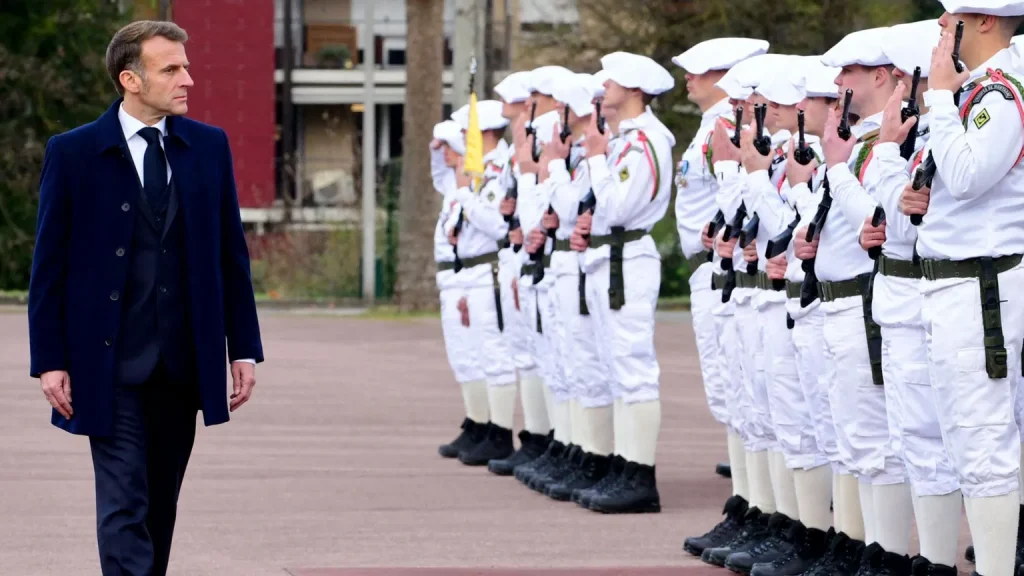
President Emmanuel Macron unveiled the plan during a visit to an infantry base near Grenoble, emphasising that “the only way to avoid danger is to prepare for it.” He described the new initiative as “an act of trust in our youth,” positioning it as a national effort to reinforce France’s defence capabilities.
A New Military Model for a New Generation
The service — aimed primarily at 18- and 19-year-olds — will offer 10 months of paid military training, with volunteers receiving at least €800 per month.
The programme will be phased in gradually:
-
3,000 volunteers will be admitted next year,
-
the number is expected to grow to 50,000 annually by 2035.
France currently maintains roughly 200,000 professional soldiers and 47,000 reservists. The new structure adds a third tier — volunteers — who will help support non-combat operations and ease the burden on professional troops.
France Joins a European Trend
Several European countries have reactivated or reformed military service due to Russia’s aggressive stance:
-
Belgium and the Netherlands introduced voluntary military service.
-
Germany is drafting a hybrid service model.
-
Lithuania, Latvia, and Sweden have compulsory schemes.
-
Finland and Greece retained mandatory conscription throughout.
France’s new plan aligns it with this broader European movement toward renewed defence preparedness.
Military Leadership Welcomes the Initiative
Top military officials in France have expressed strong support for the programme. They see it as a way to build a pool of trained individuals capable of reinforcing professional units and assuming non-frontline roles.
Thomas Gassilloud, head of the National Assembly’s defence committee, commented:
“We went too far toward a fully professional force. This new model allows for hybridisation — a blend of professionals, reservists, and volunteers.”
Several officers also hope that volunteers will eventually choose to pursue full-time military careers.
Growing Fears of a Potential Conflict with Russia
The urgency behind the reform is clear. France’s newly appointed Chief of Defence Staff, General Fabien Mandon, made headlines when he said France’s military planning is based on the assumption of a potential confrontation with Russia within three to four years.
He went further during a meeting with local officials, warning that France must be psychologically prepared for the possibility of “losing children” in a future conflict.
The remarks were condemned by the far-left and segments of the far-right, and government officials privately indicated that the general’s comments were “unhelpful.” Macron sought to reassure the public, stating that young recruits would not be sent to fight in Ukraine.
Public Opinion Strongly in Favour
Polls show broad support for the new military service:
-
73% of French citizens approve of the initiative,
-
even among 25–34-year-olds, 60% express support.
A BBC street survey in Paris reflected similar sentiments.
Louis, a 22-year-old student, said:
“It’s a good thing. It strengthens the army and helps young people feel more connected to the country.”
Another student, Eilan, added:
“You learn to communicate, trust, and live alongside people from different backgrounds.”
A Symbolic Shift — or the Beginning of a New Era?
Experts say the measure signals a significant evolution in France’s defence doctrine. While it does not reintroduce full conscription, it establishes a scalable, hybrid model capable of responding to future crises.
The programme suggests that France — like much of Europe — believes the coming years may be far less stable than the decades that followed the Cold War.
Whether this reform will produce a stronger military force or spark new domestic debates remains to be seen, but one thing is certain: France is preparing for a future defined by strategic uncertainty.