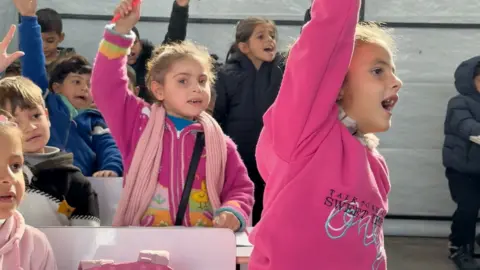
Children in Gaza Return to School After Years Without Formal Education
Children in Gaza Return to School After Extended Educational Disruption
In Gaza, the sound of children learning can be heard once again. Energetic, the tents that now serve as classrooms are filled with activity. Teachers point to boards filled with letters in English or invite students to write basic words in Arabic, creating a vibrant atmosphere, albeit far from a typical school day.
Following the ceasefire between Israel and Hamas in October, this return brings hope. After two years of war, the buzz of lessons and classmates resonates in the ruins of the former Lulwa Abdel Wahab al-Qatami School, located in the Tel al-Hawa neighborhood of southwestern Gaza. The school, damaged in January 2024, had served for months as a shelter for displaced families. Now, it is once more a place of learning, albeit in a simpler form.
Students, with their small arms resting on each other's shoulders, smile as they head towards the makeshift classrooms. For many, this marks their first return to routine and education since the onset of the war. According to UNICEF, over 97% of schools in Gaza have been affected or destroyed during the conflict.
Naeem al-Asmaar, a 14-year-old, attended this school before its destruction. He lost his mother during an Israeli airstrike during the war. "It was the hardest thing I have ever been through," he whispers. Although displaced for months, his home in Gaza survived. After the ceasefire, he returned with his family. "I missed school so much," Naeem added.
Rital Alaa Harb, a ninth-grade student, dreams of becoming a dentist. "Displacement completely affected my education," she says. "I didn't have time to learn. There were no schools. I missed my friends and I miss the times before."
The emergency school is coordinated by UNICEF and brings together children from the original Lulwa School and others displaced due to the war. It does not teach the entire Palestinian curriculum but focuses on core subjects: Arabic, English, Math, and Science. The principal, Dr. Mohammed Saeed Schheiber, who has been in education for 24 years, took over the management of the institution in mid-November. "We started with determination," he said, "to make up for what the students have lost."
The school operates in three shifts daily, attended by 1,100 boys and girls, with boys coming on alternate days. Currently, there are only 24 teachers. "Before the war, students learned in fully equipped schools - science labs, computer labs, internet access, educational resources. All of that is gone," explained Dr. Schheiber.
Sadly, the school has no electricity or internet, and many children face trauma. Over 100 students have lost one or both parents, experienced their homes being destroyed, or witnessed killings during the war. Every student has been affected, directly or indirectly, and a counselor organizes psychological support sessions to help them process what they have experienced.
Enrollment is already a challenge, as demand far exceeds capacity. "We already have over a thousand students here," said Dr. Schheiber. "But we only have six classrooms per shift."
For parents, the return to school brings both relief and anxiety. Huda Bassam al-Dasouki, mother of five displaced children from Rimal, shares that education has become an overwhelming challenge. "Not that education doesn't exist," she emphasizes, "but it is extremely difficult."
Despite the efforts, UNICEF and various aid agencies underline that the situation is exacerbated by restrictions on humanitarian aid in Gaza. Though Israeli bombardments continue, the determination of these children to learn serves as a source of inspiration. "Education is our foundation," asserts Kholoud Habib, a teacher. "For us Palestinians, it is our capital."