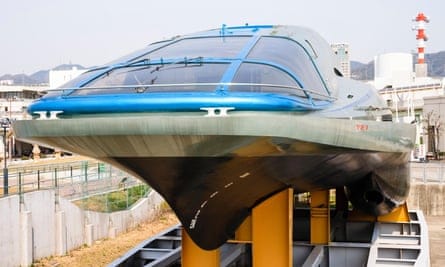
Yamato-1: Pioneering Ship Uses Magnetohydrodynamic Propulsion
Innovation in Navigation
While propellers and their derivatives remain the primary method for ship propulsion, alternative methods have been explored. One of the most fascinating is magnetohydrodynamic propulsion (MHDD), which utilizes the Lorentz force to propel a ship through water. Seawater, somewhat conductive in nature, serves as the working medium, eliminating the need for moving parts.
The Yamato-1, a full-scale prototype from Japan, was the only ship to carry humans back in 1992. Although simple in design, it spent most of its time at the maritime museum in Kobe before being decommissioned in 2016. There are two types of MHDD, based either on conduction, involving electrodes, or induction, utilizing a magnetic field. Yamato-1 employed the latter variant, utilizing superconducting coils cooled with liquid helium.
Seawater, with ions derived from dissolved salts, responds to this magnetic field by accelerating, as per the well-known right-hand rule, thereby generating propulsion. The main issue with MHDD, as used by Yamato-1, is low efficiency, with an approximate efficiency of 15% and a maximum speed of around 15 km/h (8 knots).
Research in the field of MHDD has not ceased, but the fundamental problem of seawater as an efficient fluid suggests that ships like Yamato-1 will remain a curiosity, akin to the Lun ekranoplan vehicle. Although this technology appears futuristic, it is surprisingly simple to construct a magnetohydrodynamic propulsion system even in your kitchen sink.