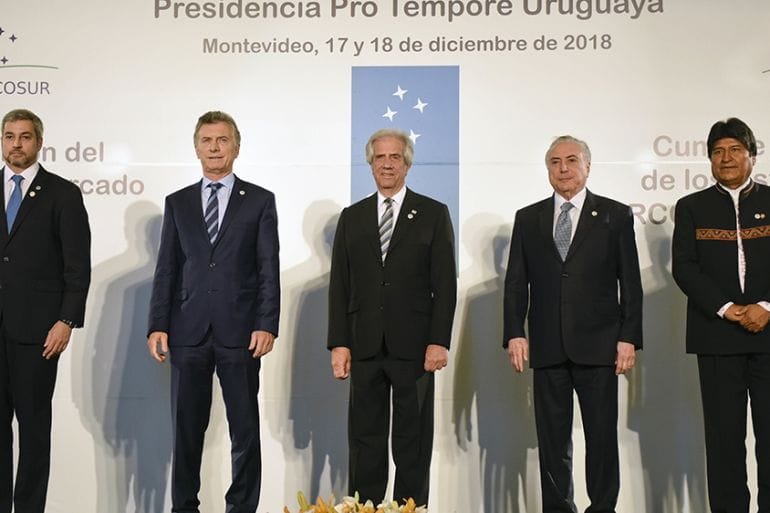
EU Signs Historic Trade Agreement with South American Bloc Mercosur
Historic Agreement Between the European Union and Mercosur
The European Union has reached a free trade agreement with Brazil, Argentina, Paraguay, and Uruguay after 25 years of negotiations, despite opposition from farmers in several European countries. The agreement with the Mercosur bloc is set to be approved by the European Parliament in the coming months.
Brazilian President Luiz Inacio Lula da Silva hailed this achievement as a "historic day for multilateralism" after the four South American countries finalized the agreement in Brussels. This agreement comes at a time of international tension marked by tariffs imposed by U.S. President Donald Trump on numerous countries and his recent military interventions in Venezuela.
The European Union has described this as the largest free trade agreement to date, considering it a "win-win for both sides," although critics argue that cheap imports could negatively impact European farmers. "In a global scenario of rising protectionism and unilateralism, the agreement is a signal in favor of international trade as a driver of economic growth, with benefits for both blocs," posted President Lula on X.
European Commission President Ursula von der Leyen stated that the agreement will bring "significant benefits for consumers and businesses on both sides." Farmers from several European countries have staged last-minute protests against the agreement, including marches and tractor demonstrations in France and Belgium. "There is a lot of pain," said Judy Peeters, a representative of a group of young farmers from Belgium, at a protest on a highway south of Brussels. "There is a lot of anger."
Von der Leyen asserted that the Commission has listened to farmers' concerns and acted accordingly, including introducing "robust guarantees" to protect their livelihoods. In addition to enhancing trade and political ties, the European Commission emphasized that the agreement will help combat climate change by committing to halt deforestation and ensuring a "reliable" flow of raw materials essential for the global ecological transition.
The Commission expects the agreement to save local companies €4 billion annually in export duties. The South American countries possess deposits of gold, copper, and some of the critical minerals necessary for renewable technology and batteries. Cecilia Malmström, former European Commissioner for Trade, told World Business Express on BBC World Service that certain parts of the trade agreement could be suspended if the Mercosur countries fail to uphold commitments regarding environmental protection. "[This agreement] is also a strong geopolitical signal today for other powers that do not value rules-based trade to the same extent as we do," she stated.
On Friday afternoon, a broad majority of EU member states confirmed their support for this free trade agreement, but it still requires approval from the European Parliament before it can come into effect. Jack Allen-Reynolds, deputy chief eurozone economist at Capital Economics, noted that the vote is expected to be close in Parliament. However, he emphasized that the larger issue is how much impact this agreement will have, referring to Commission estimates suggesting it will boost the EU's economic output by only 0.05%. "The more important point is that even if the agreement is implemented, it will be macroeconomically insignificant," he added. "And since it will be implemented gradually over 15 years, these benefits will not be felt until 2040 at the earliest."