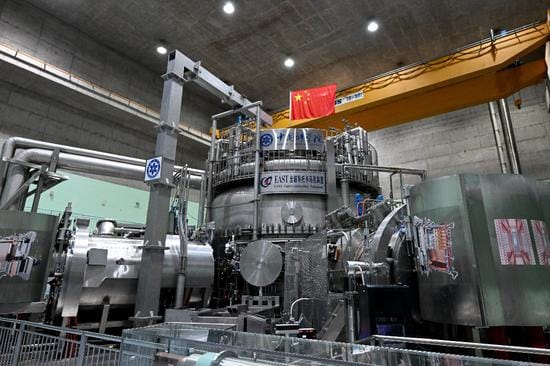
Chinese Artificial Sun Surpasses Fusion Density Barrier
Chinese Project Makes Significant Advances in Fusion Energy
Researchers working with China's fusion reactor, dubbed the "artificial sun," have successfully crossed a plasma density barrier previously deemed insurmountable by scientists. The experiment demonstrated that plasma can remain stable even at extreme densities, provided that the interaction with the reactor walls is carefully controlled. This discovery removes a major obstacle that has hindered progress toward fusion ignition.
Details of the Experiment
The results obtained by the team led by Professor Ping Zhu from Huazhong University of Science and Technology, alongside his associate Ning Yan from the Hefei Institute of Physical Sciences, were published in the journal Science Advances. They developed a new approach for operating the EAST reactors, which allows the plasma density to increase beyond traditional empirical limits without triggering the disruptive instabilities that typically affect experiments.
Involvement of Plasma Organization Theory
A new theory known as Plasma-Wall Self-Organization (PWSO) provides an alternative explanation for the emergence of density limits. According to this theory, a density-free regime can occur when the interaction between the plasma and the metallic walls of the reactor is balanced. Experiments conducted by EAST have provided the first experimental confirmation of this theoretical idea.
Future Prospects
These results offer new insights into how the density barrier in tokamak operation might be overcome in the quest for fusion ignition. Professor Zhu pointed out that the discoveries suggest a practical and scalable path for extending density limits in tokamaks and next-generation plasma-burning fusion devices. The team plans to apply the same approach in the near future, aiming to achieve a density-free regime under high-performance plasma conditions.