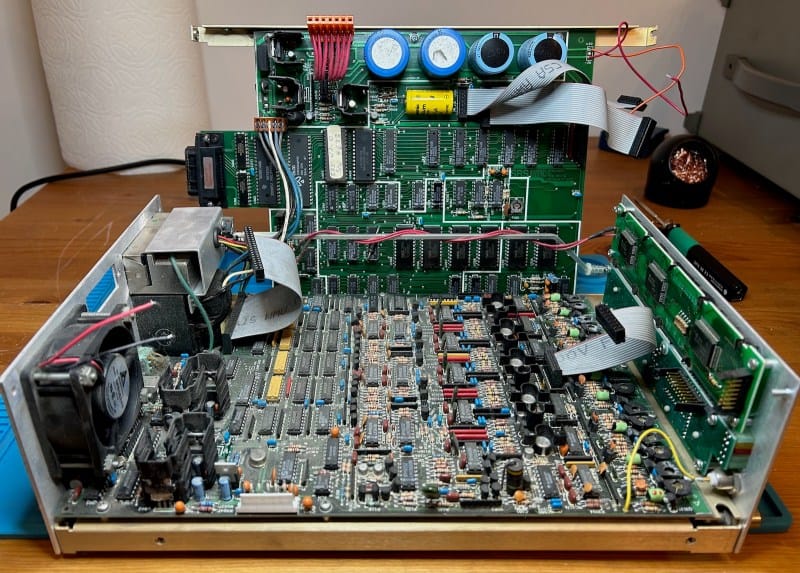
Fixing the Self-Destructing SRS DG535 Digital Delay Generator
A Surprising Find at a Flea Market
In a world filled with laboratory equipment that often proves useless for casual hobbyists, a $40 advertisement for an 1980s digital delay generator caught the attention of Tom Verbeure. Alongside the opportunity to learn about these devices, he discovered that the Stanford Research Systems (SRS) DG535 was not only broken but also had a previously activated self-destruction feature.
Technical Issues with the Generator
The SRS DG535 generator is a straightforward device equipped with an MPU Z80, allowing for programmable delays with a resolution of 12.5 nanoseconds. The main issue revolved around the power supply, where several frames were either defective or unspecified, along with a burnt trace. The self-destruction feature is triggered by the use of current-enhancing resistors around linear regulators, which can lead to destruction when the load on the power frame decreases.
Repair Attempts
After an initial unsuccessful attempt, Tom mustered the courage to try again after 18 months, using the original board schematic. The repairs were modest, involving the replacement of a discrete bridge diode with an integrated one, repairing the -9V rail with a jumper wire, and swapping out the faulty LCD with a modern version equipped with LED backlighting. Surprisingly, operating the 5V rail at 7V did not cause observable damage, and issues with loose connectors were overlooked.
Communication with SRS
When Tom inquired SRS about an updated schematic for his unit, which is still available on the market for $4,495, he was only given instructions to send the unit in for repair.