Mysterious Red Dots in James Webb Images Now Explained
Mysterious Red Dots in James Webb Images
The strange red dots in images from the James Webb Telescope have been identified as young, rapidly expanding black holes. A team of researchers from the University of Copenhagen discovered that these objects are nestled within dense clouds of gas, glowing as they consume their surroundings. Although these black holes are smaller than previously thought, they are growing quickly, offering new insights into the formation of supermassive black holes during the early stages of cosmic history.
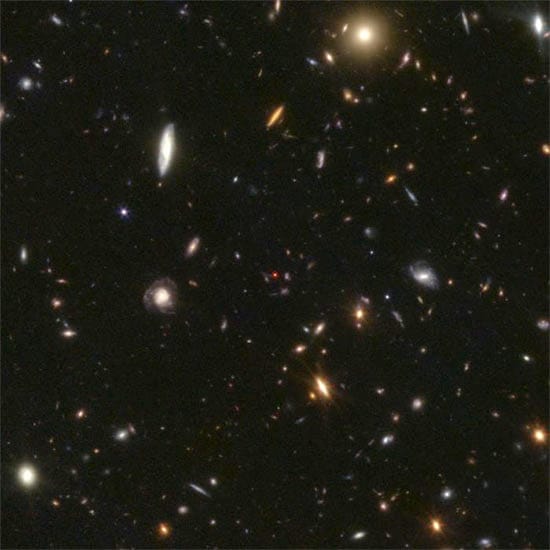
Since commencing scientific operations in December 2021, astronomers have been fascinated by the emergence of these red dots in images of the distant universe. Recent studies published in the journal Nature illustrate how these 'small red dots' existed when the universe was only a few hundred million years old. Over time, they have been observed to disappear, raising questions about the nature of these bright light sources.
“These small red dots are young black holes, with a mass of a hundred times less than previously estimated, wrapped in a cocoon of gas that they consume to grow,” explains Professor Darach Watson, one of the lead authors of the study. “This process generates immense heat, which shines through the cocoon, giving them a distinct red color.”
Astrophysicists have now identified hundreds of these small black holes, which are among the smallest ever observed. While they are massive by everyday standards, their weight reaches up to 10 million times that of the Sun. The black holes grow by pulling in gas and dust from their surroundings, and the intensity of the radiation released often pushes most material back rather than being completely consumed.
These discoveries help clarify how supermassive black holes might have existed as early as 700 million years after the Big Bang, a critical stage in cosmic evolution. “We have captured these young black holes in the midst of a rapid growth phase at a stage we have not observed before,” concludes Professor Watson.