Japan's Prime Minister Advocates for More Women's Restrooms in Parliament
Japan Adjusts Parliamentary Infrastructure to Support Women's Representation
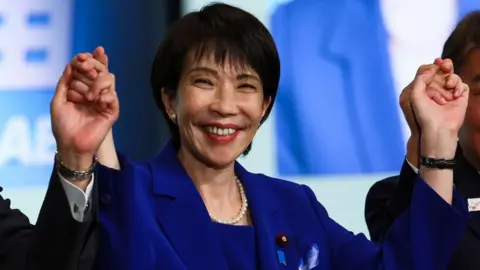
Japan's Prime Minister, Sanae Takaichi, joins 60 female parliamentarians in signing a petition to call for additional women's restrooms within the parliamentary building, amid rising female representation in the legislature. In October 2024, a record 73 women were elected to the House of Representatives, surpassing the previous maximum of 54 set in 2009.
Opposition lawmaker Yasuko Komiyama noted that there are often "long queues in front of the restroom... before the start of plenary sessions," mentioning that a colleague had refrained from using the restroom prior to a session. Currently, there is one women's restroom with two stalls near the plenary chamber, while the entire building hosts nine women's restrooms with 22 stalls, in stark contrast to the 12 men's restrooms, which contain 67 stalls and urinals.
The current situation is "often uncomfortable," as both employees and visitors share these facilities, Komiyama stated, representing the Constitutional Democratic Party. "I want my voice to be heard and to prepare for the day when women hold more than 30% of the seats in parliament in the future," she wrote on Facebook.
The Japanese parliament building was constructed in 1936, a decade before women obtained the right to vote in 1945. The first women were appointed to parliament in 1946. Additionally, the Lower House committee, led by Yasukazu Hamada, expressed its "willingness" to consider the proposal for more women’s restrooms.
The Japanese government previously set a target for 30% of leadership roles across all sectors to be held by women by 2020; however, the deadline has now been postponed by a decade. Currently, women hold nearly 16% of the seats in the Lower House and approximately one-third, or 42 out of 125 seats, in the Upper House. Takaichi, who became Japan's first female leader last October, pledged to increase women's representation in her cabinet to levels comparable to those of Nordic countries, but has only appointed two other women in her 19-member team.
Many public women's restrooms in Japan face similar issues, with long queues a common sight nationwide. Former Prime Minister Shigeru Ishiba stated that his government would take measures to "improve facilities for women's restrooms" to make Japan a society where "women can live comfortably."