Michelson Interferometer Becomes Affordable at Home
Innovation in Distance Measurement
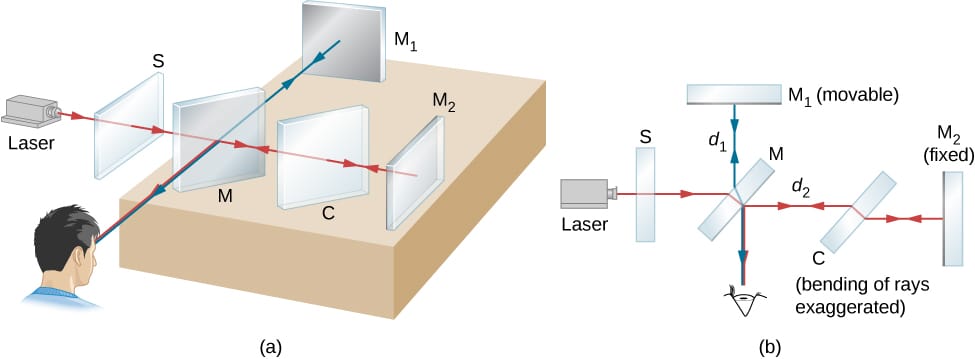
There seem to be three types of people in the world: those who have access to a Michelson interferometer and are happy about it, those who do not have one and do not know what it is, and a very small number of people who want one but do not have it. However, with [Longest Path Search] having built one using 3D printing, this last group might soon vanish. If you find yourself in the second group, a Michelson interferometer is a device designed to measure very small changes in the lengths of optical paths (simplifying, a distance). This is accomplished by splitting a laser into two parts. One part reflects off a mirror at a fixed distance from the beam splitter, while the other reflects off another mirror, usually movable. The beam splitter recombines the two beams when they return, creating an interference pattern that varies according to the differences in path length between the splitter and the mirror.
For example, if the air temperature between the splitter and a mirror changes, the change in the refractive index will cause a slight difference in the beam, which will be visible using this instrument. The device has been used to detect gravitational waves, study the sun, and the upper atmosphere, and has also helped demonstrate that light does not travel through a medium known as the aether. The tolerances for such a device are strict; however, they fall within the capabilities of modern 3D printers. CAD files are available online. The key was the mirror supports, which use springs and adjustment screws. Thus, you need some hardware and, of course, a laser, although this is no longer as hard to obtain as it once was. Obviously, the mirrors or the beam splitter cannot be 3D printed. The article states that the device is inexpensive, as the bill of materials was about $3, although this does not include the beam splitter, which would raise the cost to around $20. The device could theoretically detect changes in distance at the level of a wavelength of the laser, which is about 650 nm. Not bad for a few bucks.
Not all Michelson interferometers use lasers. The inventor of the Michelson instrument also discovered how to perform Fourier analysis using a mechanical computer.