Integrating Armed Factions Remains a Major Challenge in Syria
Challenges of Integrating Armed Factions in Syria
When the civil conflict in Syria ended in December 2024 with the collapse of Bashar al-Assad's regime, hundreds of thousands of citizens continued to possess weapons. Over nearly 14 years of war, armed factions multiplied, including a wide range of opposition groups in the northwest, military forces and militias loyal to the regime in central and western Syria, the Syrian Democratic Forces (SDF) in the northeast, and a complex network of militias in the south, not forgetting ISIS and al-Qaeda.
In this context, demilitarizing society and reunifying the country proves to be a particularly challenging task for Syria's transitional authorities. The process of disarmament, demobilization, and reintegration of armed groups, while establishing new military forces and a reform-oriented security sector, is at the heart of the state-building project in Syria.
Recently, intense conflicts between government forces and the SDF in Aleppo highlighted the consequences of the failure to address integration challenges. In December 2024, the armed forces of al-Assad's regime were quickly dissolved, and a status-setting process was initiated, allowing former soldiers to register and request release into civilian life or reenlist in the new army.
However, thousands of people opted not to participate in this process, particularly in the coastal region, where the Alawite minority dominates. Many of those who avoided the process returned to rural communities, and hundreds formed anti-government factions that carried out low-level attacks on government forces, culminating in a coordinated campaign on March 6 that killed over 100 government personnel and sparked a brutal week of violence.
In recent months, several former regime members have been trained and joined Syria's new security forces. Nevertheless, fighting continues, partly due to financial support from some of al-Assad's regime leaders now in exile in Lebanon and Russia. This undermines Syria's ability to restore ties with Lebanon and Russia and complicates the geopolitical positioning of these countries in the region.
The transitional government of Syria is also seeking to rebuild the Ministry of Defense and the Ministry of Interior, along with various public security force units. While all opposition groups have been technically dissolved, some continue to exist, forming nearly 20 divisions of the army. Certain factions with longstanding ties to Turkey receive greater military support than others.
On the other hand, the Ministry of Interior has taken over internal security responsibilities, leading to a significant improvement in the security situation in many areas of the country, including the Syrian coast.
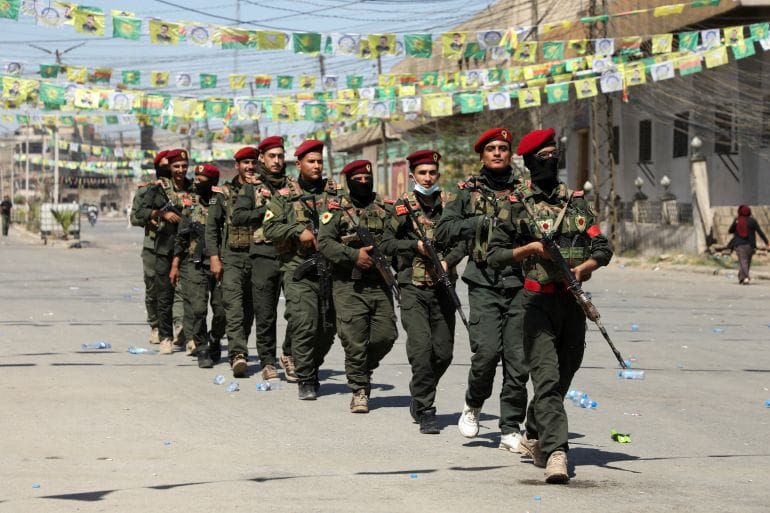
The most significant strategic challenge facing Syria's transition relates to unresolved territorial issues in the northeast with the SDF and in the south, in the predominantly Druze governorate of Suwayda. Both regions feature armed groups challenging the authority of Damascus, generating ongoing tensions and conflicts.
In conclusion, the process of integrating armed factions in Syria is closely linked to internal politics and emerging challenges within the transition, and the reaffirmed international support for the transitional government offers an essential framework to facilitate this process. However, as long as geopolitical challenges persist, integration will remain incomplete and a continuous source of instability.