Title: One Year After the Ceasefire, Southern Lebanon Still Struggles With Fear, Tension, and Uncertainty
One year after the ceasefire between Israel and Hezbollah officially came into effect, Southern Lebanon remains far from the stability promised by political leaders. Instead of a lasting peace, the region continues to face sporadic airstrikes, drone surveillance, and widespread anxiety that the conflict could reignite at any moment.
Last Friday, around 7 p.m., an Israeli airstrike hit a vehicle in the village of Froun, located deep within Lebanon’s Shia heartland. Posters honoring fallen Hezbollah fighters still decorate the narrow streets, yet conversations with residents reveal a palpable shift in sentiment. When our correspondent arrived an hour after the strike, rescue workers had already collected the remains of the only casualty — a man whom the Israeli military later described as a “Hezbollah operative.” For many locals, however, the labels have lost meaning in the face of daily fear.
“Who’s helping us?” asked Mohamad Mokdad, sweeping pieces of debris off his veranda. “I just want peace. I don’t want parties or groups, I just want a normal life.” Although he avoided mentioning Hezbollah by name, his tone suggested a growing frustration shared by many in the region.
The ceasefire brought an end to a 13-month conflict that killed more than 4,000 Lebanese and 120 Israelis. According to the agreement, Hezbollah was required to withdraw its fighters and weapons to the north of the Litani River, while Israeli troops had to retreat from southern Lebanese territories they occupied during the war. The Lebanese army, supported by UN peacekeepers (UNIFIL), was tasked with taking full control of the area.
A year later, little has changed on the ground. Israel still occupies at least five strategic hilltops in the south, while air and drone strikes continue almost daily. UNIFIL reports more than 10,000 ceasefire violations committed by Israel, and Lebanon’s health ministry says over 330 people have been killed since the truce began, including civilians.
Israel claims that Hezbollah has resumed rebuilding its military infrastructure south of the Litani and attempted to smuggle weapons into Lebanon, while focusing increasingly on the production of explosive drones. Though Israel says it possesses evidence, it has not publicly presented any. Meanwhile, Israeli media have been filled with reports suggesting preparations for a new escalation.
The village of Beit Lif has become a symbol of this renewed tension. Last week, the Israeli military released a map labeling several dozen locations in the village as Hezbollah infrastructure. Fearing an imminent strike, residents appealed to the Lebanese army to deploy troops. Soldiers arrived briefly at night, patrolling the streets before departing at dawn without inspecting private homes — a move widely interpreted as an attempt to avoid being seen as cooperating with Israel.
“There are no militants here. No weapons,” insisted the village mayor, Ezzat Hammoud. “If there were, I wouldn’t say this publicly.” Yet some residents, like Haider, chose to escort journalists through their homes, believing that visibility might offer some protection. “We want stability, not war,” he said. “But we are tired. Completely worn out.”
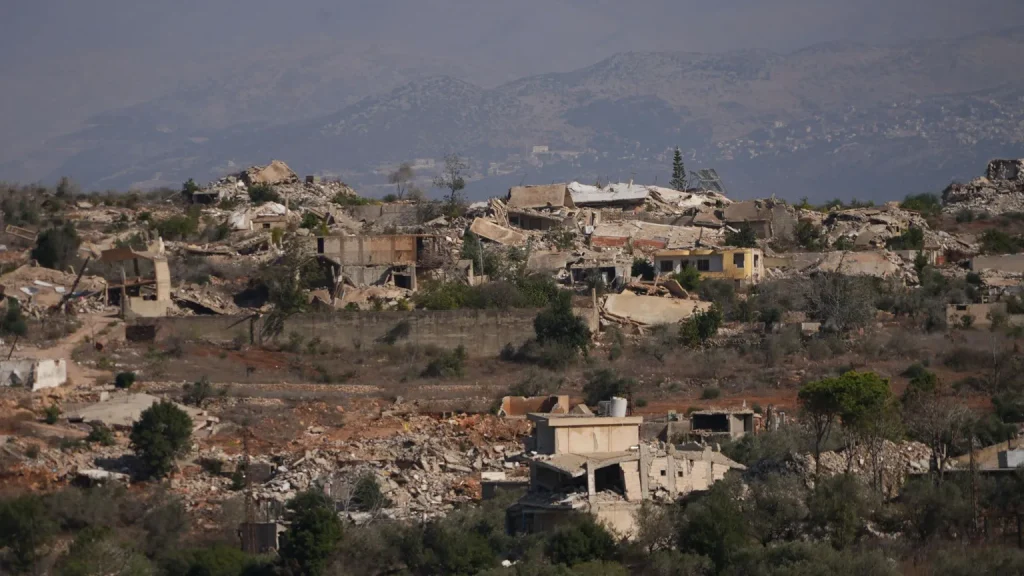
In Yaroun, a border village largely destroyed during the war, the constant buzzing of Israeli drones fills the skies. “This happens 24/7,” said Nayef al-Rida, one of the few remaining inhabitants. “Everyone is afraid. When you leave, we will stay here… alone. This isn’t life.”
International donors have so far refused to fund reconstruction in southern Lebanon, largely due to the ongoing dispute over Hezbollah’s weapons. Lebanese leaders warn that any attempt to disarm the group by force could ignite internal conflict and plunge the country into deeper chaos.
For now, ordinary civilians remain trapped between the political posturing of regional powers and the unpredictability of a fragile ceasefire. In Southern Lebanon, peace is not a lived reality but a distant hope — overshadowed by the fear that the next explosion could come at any moment.