Rail Disaster at Adamuz: Early Signs of a Systemic Safety Crisis on Spain’s High-Speed Network
Trains at the Brink of Disaster: What Happened near Adamuz
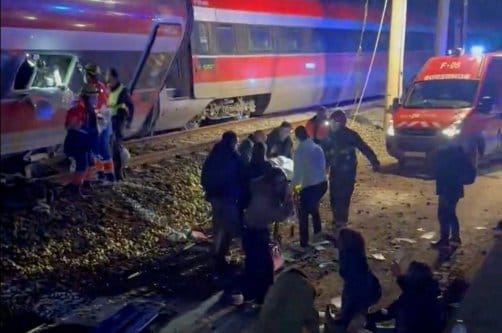
A high-speed train departing Málaga bound for Madrid derailed and crossed onto an adjacent track, colliding with an oncoming service and causing mirror-image derailments of both trains near the town of Adamuz, outside Córdoba. Authorities have reported at least 21 fatalities and dozens injured, including 73 people in serious condition, while rescue teams continue extraction operations among twisted carriages. The collision occurred shortly after the southbound service left Málaga; the private operator Iryo has confirmed approximately 300 passengers were on board.
An RTVE journalist who was aboard described the impact as seismic, noting the sudden, violent jolt that overturned multiple carriages.
Initial Indicators: From Derailment to Simultaneous Collision
The event—one train derailing and coming to lie on the neighbouring track, triggering derailments in both directions—implies an extremely rapid sequence of failures. Several technical and operational lines of inquiry must be pursued: the condition and operation of track switches and points, the structural integrity of the track segment, the performance of automated high-speed protection systems, and the role of human factors. At this stage the facts are insufficient to draw definitive conclusions. Forensic reconstruction will rely on onboard recorders and ‘black box’ data, telemetry and signalling logs from Adif, and operator records to establish the chronology and mechanics of the initial derailment.
Technical Hypotheses That Cannot Be Ignored
A common cause of such cascades is a failure at a turnout or switch. If a train derails due to a track defect or equipment fault and encroaches on the neighbouring line, a domino effect is likely. Loss of braking capability caused by a fault in brake-by-wire systems, erroneous speed sensor data, or a failure of automatic train protection systems—such as ETCS or national ATP implementations—could explain an inability to stop the train in time. Human error, whether by the driver or at the dispatching level, remains a credible hypothesis. Only a rigorous technical investigation will allocate responsibility and identify the proximate and underlying causes.
A Familiar Wound: Spain’s High-Speed Accident Memory
The spectre of the 2013 Santiago de Compostela crash, which claimed 79 lives, hangs over public perception and institutional response. In that case, the absence of automatic speed control on the critical stretch was a decisive factor. Citizens, experts and regulators will now ask whether the lessons from Santiago have been fully internalised: whether deployment of modern protection technologies has been prioritised, and whether oversight functions operate effectively across a mixed public–private landscape.
Adif, Iryo and the Map of Responsibility
Spain’s rail system separates infrastructure management (Adif) from train operations, which are provided by public and private operators such as Iryo. That separation can improve efficiency but complicates liability and accountability when things go wrong. Adif has pledged cooperation with the investigation and established family assistance points at major stations, but the technical and legal inquiries will need to examine maintenance records for the line, the history of interventions on the affected section, equipment telemetry, signalling and interlocking logs, and Iryo’s operational compliance and emergency procedures.
Emergency Response: Between Organisation and Chaos
Emergency services appear to have responded swiftly, mobilising firefighters, ambulances and extrication teams—actions that are vital to reduce fatalities. Still, reports that stranded passengers waited in the cold, were later transported to a local sports centre, and encountered patchy communication with relatives point to strains in contingency planning. Institutional public messaging has been visible, including statements from the Royal Household and the Government, but official visibility cannot substitute for robust operational preparedness and concrete preventive measures.
Political, Legal and Economic Impact
Carriage accidents of this magnitude have effects that extend well beyond immediate human tragedy. Prime Minister Pedro Sánchez’s government faces pressure to ensure full transparency in the investigation and to take tangible remedial action. Regional authorities in Andalusia have expressed support for victims, but coordinated multi-level governance will be required to manage the crisis. Legally, both criminal and civil proceedings are likely to follow, and companies involved will face scrutiny. Economically, any prolonged suspension of services on the Madrid–Andalusia corridor would damage tourism, business travel and passenger confidence. Private operators must demonstrate safety standards at least equal to public providers.
What Must Be Verified in the Coming Days
Investigators will prioritise several critical data sources: onboard recorder files for each train, speed and command logs, the state of switches and rails at the site, maintenance histories, dispatcher–driver communications, and the status of automatic protection systems at the time of the incident. Rapid access to these data and close interinstitutional cooperation will determine whether the public receives timely, clear answers or whether the process is prolonged by technical and legal disputes.
The Warhial Perspective
The Adamuz tragedy reopens an old wound: how resilient is a modern high-speed rail system when faced with catastrophic failures? This moment should be a reckoning between the demonstrated technical performance of high-speed rolling stock and the persistent vulnerabilities of infrastructure and human coordination. Warhial holds that authorities cannot afford delay. Immediate mandatory steps should include full transparency during the investigation, swift publication of all relevant technical data, and a temporary moratorium on the operation of similar track sections until thorough inspections are completed. In the medium term, the state must accelerate the rollout of automatic train protection across all lines and mandate independent, periodic safety audits for both Adif and private operators.
Forecast: the inquiry will most likely reveal a confluence of contributing factors rather than a single causal failure. It is improbable that one isolated technical defect alone produced this outcome; more plausibly, investigators will find a mix of unfinished corrective actions, potential maintenance gaps and limitations in operational coordination. The political and social reaction will force reforms, but the pace of those reforms will determine whether real safety improvements follow or whether measures remain rhetorical and superficial. Absent a bold, transparent response, public confidence in high-capacity rail travel will remain fragile, and the social and economic costs of this accident will persist long after the immediate emergency has passed.