Testing the New Walnut Pi Board Based on Allwinner
Introduction to Walnut Pi 1B
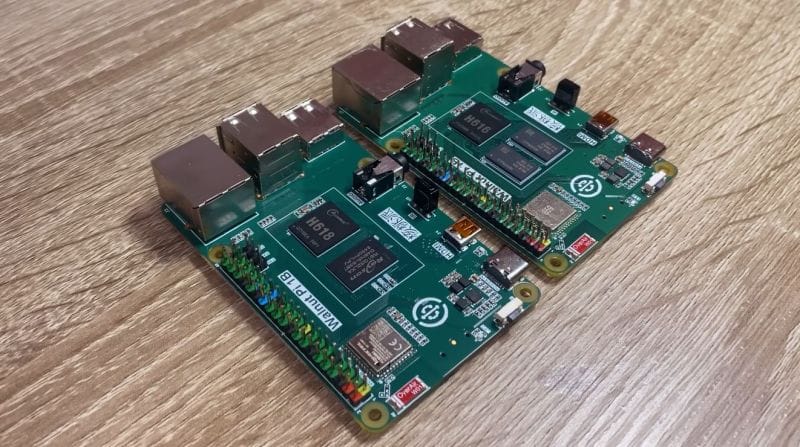
When it comes to the term "Raspberry Pi clone," the primary aspect that is reproduced is the form factor, as nobody creates clones of the SoCs based on Broadcom's VideoCore. However, the Walnut Pi 1B board, recently reviewed by [Silly Workshop], seems to adopt a relatively standard approach for a board compatible with the Raspberry Pi 4. Part of the Walnut Pi series, the 1B model is equipped with the Allwinner H616/H168, taking inspiration from both the Raspberry Pi 4B and Asus Tinkerboard, particularly due to its colorful GPIO pins.
Specifications and Conclusions
There is also a higher-performing variant, the Walnut Pi 2B, which comes with the Allwinner T527 SoC, but this is not analyzed here. According to the translated documentation in Chinese, both H616 and H618 can be installed, featuring a Cortex-A53 quad-core processor, placing them near the Raspberry Pi 3 in performance. Multiple RAM configurations are available, ranging from 1 GB DDR3 to 4 GB LPDDR4, with the 1 GB version suitable for benchmark tests like GeekBench. Overall, the impression is that it is just another board based on the Allwinner SoC, with a superficial 'customized' Linux image and lacking hardware acceleration due to the absence of drivers for Allwinner's proprietary IP blocks. Although it is cheaper than a Raspberry Pi SBC, if you need more than basic support for the Allwinner H61* and Ethernet/WiFi, there are clearly better options available, some of which may include repurposing an old Android TV box from electronic waste.