Midterm Elections Shift: How Recent Court Rulings Are Reshaping the US House of Representatives
The American political landscape is experiencing a seismic shift as the crucial midterm elections approach. Just three weeks ago, many political strategists and Republicans were feeling incredibly gloomy about their chances of keeping a majority in the US House of Representatives. However, recent developments have drastically altered the playing field, setting the stage for a fiercely contested battle this November.
A Sudden Shift in Political Momentum Initially, the Republican Party was facing significant headwinds. Donald Trump's approval ratings had taken a noticeable hit, largely driven by public perception of his handling of the economy, soaring inflation, and the ongoing geopolitical fallout in the two months since the start of the Iran War. Furthermore, early Republican attempts to gain a partisan advantage by strategically redrawing congressional district lines—a process widely known as gerrymandering—in Texas and a handful of other conservative-dominated states had been effectively offset by aggressive Democratic responses in blue states like California and Virginia.
"If the election were in May, Republicans would lose," former Republican Speaker of the House Newt Gingrich frankly told the New York Times in April. "The war, the sense of affordability and gasoline – some of that has to be cleared up in order to win."
The Legal Tsunami: Court Rulings Change the Game The political calculus changed practically overnight following two monumental court decisions. Last week in Virginia, the state's supreme court delivered a massive blow to Democrats by nullifying a recent voter referendum that had approved the state's new electoral maps. Those maps likely would have flipped four previously Republican seats directly into the Democratic column.
"Republicans have momentum heading into November," Congressman Richard Hudson, who runs the House Republican campaign committee, declared in an enthusiastic statement following the Virginia ruling. "We're on offense, and we're going to win."
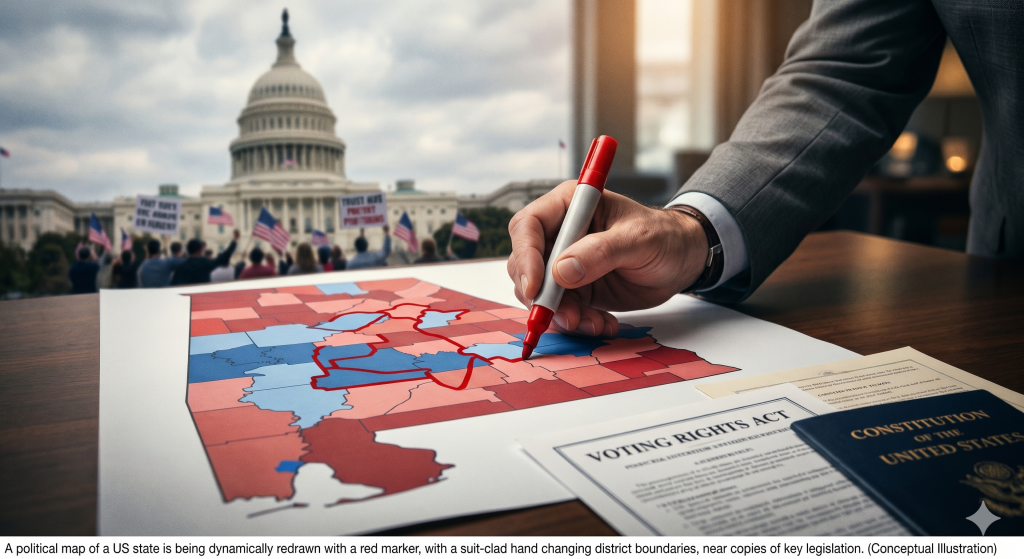
The week prior, the US Supreme Court delivered an even more consequential verdict. Reversing a decades-old precedent, the conservative majority ruled that the Voting Rights Act—a landmark piece of legislation passed during the peak of the Civil Rights movement of the 1960s—did not require states to create congressional districts providing minority voters with the opportunity to elect candidates in proportion to their overall population.
The court ruled that only overt, explicit racism was grounds for nullifying a state's congressional map. Consequently, "gerrymandering" districts purely to provide a partisan advantage is considered constitutional, even if it has the secondary effect of diluting minority voting power.
The Ripple Effect Across Southern States This sweeping Supreme Court decision prompted a series of Republican-dominated southern states to immediately scramble. Their goal was to dismantle court-mandated "majority-minority districts"—which, due to historical and demographic political preferences, were mostly held by black Democrats—and replace them with districts heavily skewed in favor of Republican candidates.
Tennessee was the very first state to act, quickly approving a map that gives Republicans the definitive upper hand in all nine of the state's congressional districts. In the early hours of Tuesday morning, the Louisiana Senate aggressively pushed through a map that is highly likely to flip one of the state's two remaining Democratic districts. The Republican governor even delayed the state's congressional primary to accommodate the swift change. Alabama is currently taking steps to follow suit. While a handful of Republicans in the South Carolina legislature joined Democrats to block a similar move, the governor may call a special session to force the issue.
A Daunting Task for the Democrats When combined with a highly partisan Florida redraw approved the same day as the Supreme Court's ruling, a redistricting fight that once appeared to be a stalemate is now poised to give Republicans the upper hand in at least eight new seats. With the party currently holding a razor-thin 218 to 212 majority, the task for Democrats to take back the chamber has become monumentally daunting.
"These recent changes have left Democrats with significantly less room for error," notes Geoffrey Skelley of the election analysis website Decision Desk HQ.
However, political headwinds may still play a massive role. Even a highly favorable redistricting map may not save Republicans in November if Trump continues to be deeply unpopular. In the 2018 midterms, when the president's favorability ratings were actually higher, Democrats won 235 seats.
"Given the highly unfavorable political environment confronting House Republicans, the extremists will not meaningfully benefit from their scandalous gerrymandering scheme," Hakeem Jeffries, the Democratic leader in the House, wrote in a defiant letter to his colleagues. Promising a "total war" against these tactics, Jeffries added, "Our effort to forcefully push back against the Republican redistricting scheme will not slow down. We are just getting started."