Pope Leo XIV Begins First Foreign Trip in Turkey, Warning That “The Future of Humanity Is at Stake”
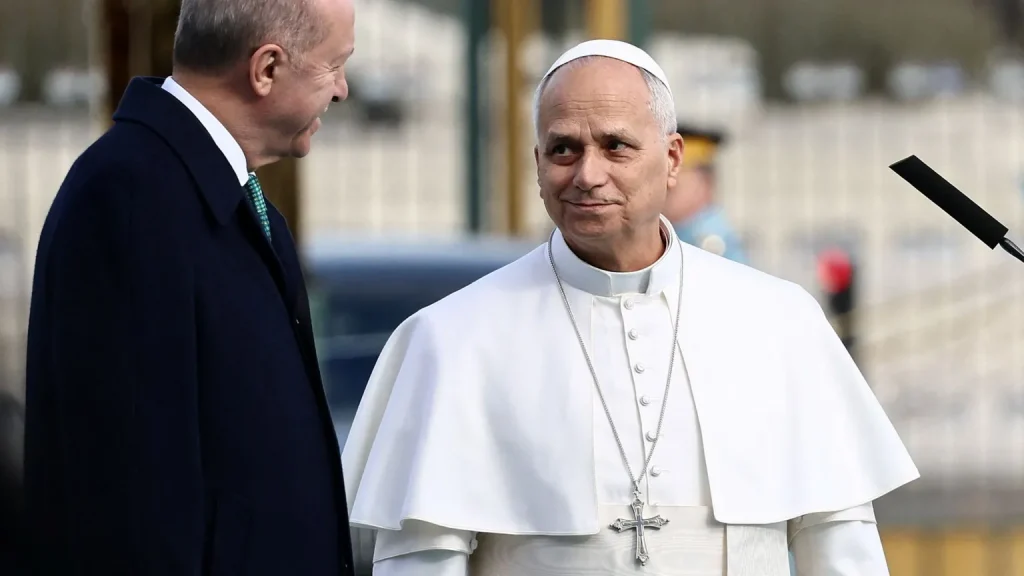
Pope Leo XIV has begun his first official foreign visit with a stark message to world leaders: global tensions are rising to levels that threaten the stability of humanity itself. Arriving in Ankara on Thursday, the newly elected pontiff was welcomed with full state honors by Turkish President Recep Tayyip Erdoğan, marking the beginning of a high-stakes diplomatic tour that will include both Turkey and Lebanon.
Speaking alongside Erdoğan, Pope Leo declared that the international community must resist “the heightened level of conflict that is taking hold across the world,” urging nations to act with renewed responsibility. “The future of humanity is at stake,” he said. “We must be builders of dialogue, not agents of division.”
A World on Edge
The Pope’s remarks come amid escalating wars and geopolitical tensions. With the war in Ukraine dragging on, violence continuing in Syria and Myanmar, and Israel’s recent airstrikes in Beirut, the Vatican insists that the global community is entering a dangerous era.
Since becoming pontiff six months ago, Pope Leo has been known for his cautious and measured tone. Yet this trip marks a test of his diplomatic skill: his words will be dissected not only by political leaders but also by religious communities seeking guidance in troubled times.
Turkey as a Strategic Centerpoint
During his Ankara address, Pope Leo emphasized Turkey’s critical geopolitical position as a bridge between cultures, continents, and religious traditions.
“Turkey stands at the crossroads of worlds,” he said. “Your role in promoting peace and stability is more vital than ever.”
He also highlighted the importance of interfaith cooperation, announcing his plan to visit Istanbul’s Blue Mosque, following in the footsteps of Benedict XVI and Francis. The Vatican sees such gestures as essential in countering narratives of division between Islam and Christianity.
A Historic Moment in Iznik
One of the most symbolically important events of the trip will take place in Iznik—the ancient city of Nicaea. There, 1,700 years ago, the First Council of Nicaea convened, shaping key doctrines of Christianity, including the Nicene Creed.
Pope Leo will join leaders from various Christian traditions to commemorate the council’s anniversary, with speeches expected to highlight unity, mutual respect, and the healing of centuries-old divisions between Eastern and Western Christian communities.
Next Stop: Lebanon
Following his visit to Turkey, Pope Leo will continue to Lebanon, despite concerns raised after recent Israeli airstrikes on Beirut. Vatican officials insist that the schedule will not change, emphasizing the importance of supporting communities suffering from political instability and economic collapse.
In Beirut, the Pope will meet young people from different religions and preside over a Mass at the site of the 2020 port explosion. He is expected to call for peace, accountability, and a renewed social vision for a country struggling with profound crisis.
A Different Leadership Style
Pope Leo’s style contrasts markedly with that of Pope Francis. While Francis was known for bold political statements and symbolic gestures, Leo has positioned himself as a unifier who seeks internal harmony within the Church.
His ability to appeal simultaneously to progressives and traditionalists has already made him an unusual figure — one whose leadership is rooted in careful balance. This diplomatic trip will show whether he can extend that balance to the volatile international arena.
A Pope Who Sounds American
One notable detail confirmed by the Vatican is that Pope Leo will deliver his speeches in English during the Turkish leg of the trip. Born and raised in Chicago, he speaks with a distinct American accent, which will likely draw attention from audiences unaccustomed to hearing it from the head of the Catholic Church.
A Crucial Moment for Global Diplomacy
The world will be watching closely as Pope Leo engages political and religious leaders over the coming days. His closing press conference on the flight back to Rome—traditionally a moment of candid reflection for modern popes—may offer insight into his developing view of how global conflicts can be de-escalated.
For now, his message is clear: humanity stands at a crossroads, and the urgency of pursuing peace has never been greater.