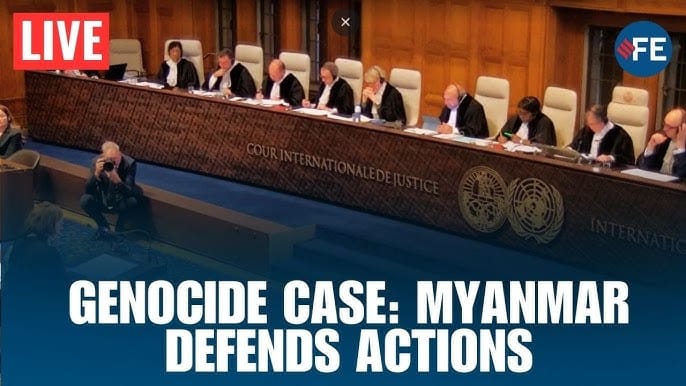
Myanmar Defends Its Position in International Court Regarding Rohingya Genocide Case
Myanmar's Defense at the International Court of Justice
Myanmar has begun presenting its defense in a controversial genocide case, asserting that Gambia has not provided sufficient evidence to support the allegations. Government representative Ko Ko Hlaing stated before the judges of the International Court of Justice (ICJ) that these accusations are "baseless".
During a trial that commenced this week, Gambia's Foreign Minister, Dawda Jallow, claimed that Myanmar intends to erase the Rohingya Muslim minority through "genocidal policies".
The Rohingya crisis erupted in 2017, when tens of thousands were killed, and over 700,000 fled to Bangladesh due to a brutal military crackdown. A 2018 UN report called for investigations into military leaders for genocide crimes in Rakhine state.
Hlaing emphasized that Myanmar cannot remain passive in the face of terrorist threats from areas populated by Rohingya, insisting that its actions were justified as counter-insurgency operations.
Gambia initiated the case against Myanmar in 2019, invoking its own experience with a military government. Gambian lawyers argued that attacks on civilians are difficult to justify in the context of combating terrorism.
One of the attorneys, Philippe Sands, asserted that the evidence presented indicates a "genocidal intent" that has led to numerous state actions against the Rohingya.
Currently, over one million Rohingya refugees reside in the Cox's Bazar region of Bangladesh, in one of the largest and most crowded refugee camps in the world.
Before the court, Hlaing stated that Myanmar is committed to the repatriation process for individuals from Rakhine state, noting that external factors, such as the COVID-19 pandemic, have complicated this effort.
The court has set a three-day deadline for witness hearings, including Rohingya survivors, with a final ruling expected at the end of 2026.