Chile Ablaze: When Summers Become Catastrophes
The Fire That Shattered the Pacific Coast's Quiet
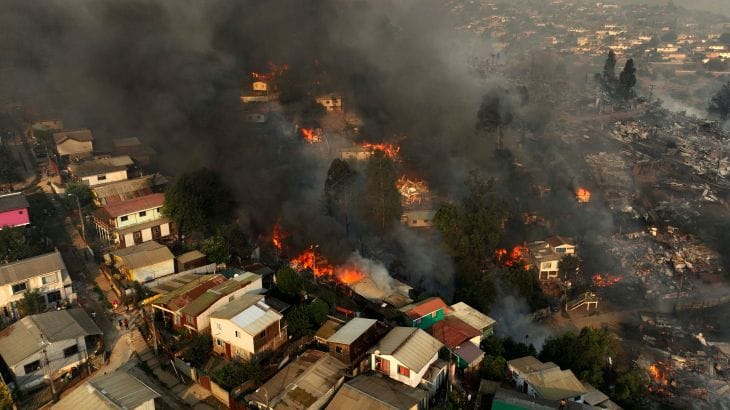
The Ñuble and Biobío regions, roughly 500 kilometres south of Santiago, are the epicentres of one of the most severe natural crises Chile has faced in recent years. Wildfires have claimed at least 18 lives, destroyed hundreds of homes and forced the evacuation of more than 50,000 residents. President Gabriel Boric has declared a state of catastrophe for the two regions, enabling the mobilisation of the armed forces to support rescue and civil protection operations. Streets bear the visible aftermath: charred vehicles, homes reduced to ash and aggrieved communities grappling with shock and loss.
Wind, Extreme Heat and Drought: A Deadly Combination
The scale of the blazes is not an isolated accident. Chilean forestry authorities report dozens of active fires nationwide, with the most threatening concentrated in Ñuble and Biobío. More than 8,500 hectares have already burned in these regions alone. A convergence of meteorological factors has turned isolated fires into rapidly advancing fronts. Strong gusts scatter embers across great distances while temperatures forecast to reach 38 degrees Celsius dry fuels and accelerate combustion. A prolonged drought has transformed forests and cropland into tinder. In this environment, fuel management—both in forests and agroecosystems—becomes as crucial as firefighting capacity.
Mass Evacuations and Urban Vulnerabilities
Urban and peri-urban communities have been tested in real time. Cities such as Penco and Lirquén, adjacent to Concepción, faced intense pressure: hospitals and residential areas were evacuated, roads were closed and essential services were disrupted. Authorities estimate around 20,000 people were displaced from critical zones. While approximately 250 dwellings have been documented as destroyed, social and psychological losses in affected communities far exceed property counts. The crisis exposed weaknesses in evacuation planning, shelter capacity and emergency communications. When fire behaviour can change direction within minutes, the mobility of vulnerable groups—seniors, the chronically ill and economically marginalised families—becomes the difference between life and death.
Institutional Bottlenecks and the Military Option
Declaring a state of catastrophe grants extraordinary powers to the central government, from the mobilisation of armed forces to the reallocation of emergency funds. While military support for civil operations can be decisive in search and rescue, logistics and enforcement, it is not a substitute for sustained civil planning. The crisis raises critical questions about the capacity of Chile's civil protection agencies, the adequacy of local funding and the effectiveness of multilevel coordination among municipalities, regional authorities and national ministries. Long-term resilience depends on strengthening those civilian institutions and clarifying the respective roles of military and civilian responders.
Recurring Patterns: A History of Conflagrations
Chile is no stranger to catastrophic fires. Two years ago, regions around Valparaíso suffered devastating losses with more than 120 fatalities. A repeating pattern is now evident: hotter summers, prolonged drought spells and blurred boundaries between forests, agricultural land and urban expansion create conditions ripe for large-scale fires. This trend is not unique to Chile; Mediterranean-climate zones worldwide—from southern Australia to California and the European Mediterranean—are experiencing higher frequency and intensity of wildfires as climate variables shift.
Economic and Ecological Costs Over the Long Term
Immediate direct costs are straightforward to enumerate: rebuilding homes, medical and emergency response expenses, damage to infrastructure and compensation for affected farmers. But medium- and long-term costs are more complex and enduring. Ecosystem restoration, soil erosion, altered hydrological cycles and biodiversity loss have cascading effects on regional economies. Forestry industries, regional tourism and local agriculture will feel the consequences for years. Investments in ecological regeneration will compete with other budgetary priorities in a politically charged environment, making recovery slower and more contentious.
What Is Missing: Climate-Aware Prevention
Emergency response remains essential, yet prevention tailored to a changing climate is the principal shortfall. Effective measures include controlled fuel reduction, establishment and maintenance of defensible buffer zones around settlements, early warning systems and modernised firefighting equipment. Greater investment in water infrastructure for firefighting and community-level preparedness are also critical. Crucially, prevention requires integrated policies that account for climate change: land-use planning that restricts urban sprawl into high-risk zones, incentives for resilient agricultural practices and legal tools for sustainable land management. International cooperation for technology transfer and material support can accelerate implementation, but domestic political will and funding are indispensable.
‘In light of the severe ongoing fires, I have decided to proclaim a state of catastrophe’ — President Gabriel Boric
Regional Lessons and Cooperative Responses
Global experience provides a menu of adaptable solutions. Australia and California have developed advanced coordination mechanisms for civil-military cooperation, established sophisticated fuel management regimes and refined evacuation protocols through repeated practice. Transferring these practices to Chile requires adaptation to local realities—topography, population distribution, land tenure and sociocultural factors all shape what will work. Regional solidarity, including the sharing of aerial firefighting capacity, specialised ground teams and technical expertise, can shorten response times and reduce loss of life. Multilateral arrangements for emergency assistance should be part of contingency planning well before the next peak season.
Signs of a Society Transitioning Under Climate Stress
The current fires are symptomatic of a broader climate-driven transition. They are not merely seasonal anomalies but indicators of structural change that will impose recurring social and economic costs. Effective adaptation will demand more than ad hoc funding and reactive measures. It requires rethinking territorial planning, community integration in risk governance, and a shift in how forests and agricultural lands are managed. Building adaptive capacity means embedding resilience across policy domains: public health, infrastructure, social services and environmental regulation.
The Warhial Perspective
Chile is at a crossroads. The present conflagrations constitute an immediate humanitarian emergency and a decisive test of institutional adaptability. While the state of catastrophe is a necessary instrument for short-term crisis management, it is insufficient without a concerted National Wildfire Prevention Strategy backed by stable funding, legislative tools for land stewardship and mechanisms for meaningful community participation. Politically, the Boric administration must translate emergency mobilisations into a coherent long-term policy that reduces both urban and rural vulnerability. Failure to do so will entrench a cycle of recurring disasters, fuel public discontent and erode trust in public institutions.
Projected climatic trends suggest an intensification of fire seasons: hotter summers will lengthen windows of extreme fire risk and increase the probability of more severe episodes. If investments in prevention are delayed and territorial occupation is not reconfigured with risk in mind, Chile risks normalising destructive wildfires as a tragic regularity. The solution must be hybrid: deploy modern technologies for detection and suppression, enact robust public policies for prevention and land use, and cultivate broad-based social engagement in resilience building. Only a combined approach will reduce burned area over time and restore the capacity of communities to live safely and sustainably within a transforming climate.