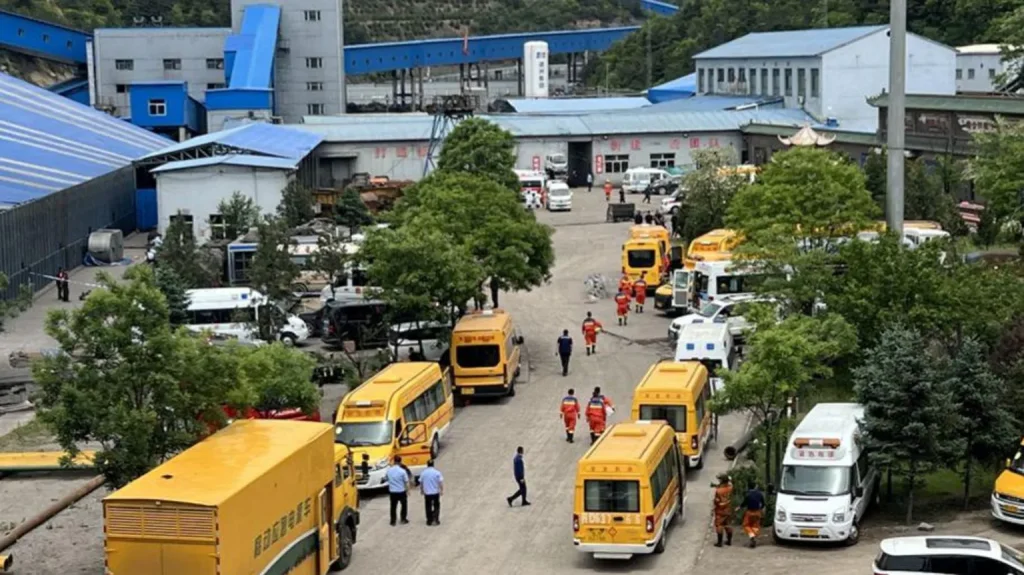
Tragic Coal Mine Explosion in China Claims Over 90 Lives: A Deep Dive into the Disaster
A catastrophic gas explosion has struck China’s coal mining industry, leaving at least 90 people dead and dozens injured. The blast, which occurred at the Liushenyu Coal Mine in the northern Shanxi province, is now marked as the deadliest mining disaster the country has witnessed since 2009. This profound tragedy has reignited intense scrutiny regarding industrial safety standards within a region critical to the nation's energy supply.
Timeline of the Incident and Casualties
The disaster unfolded on Friday at 19:29 local time (22:29 GMT). At the exact moment of the explosion, there were 247 workers on active duty underground. Immediate emergency responses successfully pulled more than 100 individuals to safety.
The current human toll stands at:
-
At least 90 confirmed fatalities.
-
27 individuals receiving hospital care, with one in critical condition.
-
The majority of the non-fatal casualties sustained injuries from inhaling poisonous gas, a deadly occupational hazard in subterranean environments.
In a swift emergency response, China's Ministry of Emergency Management deployed 345 personnel across six specialized rescue teams to manage the harrowing extraction and search operations.
A Survivor's Harrowing Account
Wang Yong, an injured miner who survived the ordeal, provided state media with a chilling account of the disaster's onset. He noted the absence of a loud bang, describing instead a sudden, overwhelming plume of smoke.
"I smelled sulphur, the same smell you get from blasting. I shouted at people to run. As we were running I could see people collapsing from the fumes. Then I blacked out too," Wang recounted. After lying unconscious for roughly an hour, he awoke, roused a nearby colleague, and managed to escape.
Investigations and Glaring Safety Violations
Chinese President Xi Jinping issued a mandate demanding that no effort be spared in the rescue and treatment of victims. He simultaneously ordered a rigorous governmental investigation to unearth the root cause of the explosion and to hold all responsible parties strictly accountable. Consequently, several members of the mine's management team have been detained by authorities.
While the exact spark that triggered the gas explosion remains undisclosed, initial investigations revealed that levels of carbon monoxide—a highly toxic, invisible, and odourless gas—had severely "exceeded limits" within the mining shafts.
The regulatory history of the Liushenyu mine paints a troubling picture of administrative negligence:
-
Prior Warnings: In 2024, the Chinese National Mine Safety Administration officially listed the facility as possessing "severe safety hazards."
-
Recent Penalties: Tongzhou Group, the corporate entity operating the mine, had already received two administrative penalties in 2025 specifically for safety protocol violations.
Economic Reality and Historical Context
Shanxi province is the undisputed powerhouse of China’s coal production, accounting for over a quarter of the country's total output. During the early 2000s, China's mining sector was notoriously dangerous, with fatal accidents occurring frequently. While comprehensive crackdowns on illegal operations and tightened safety regulations have vastly improved conditions, tragedies still occur. In 2023, an open-pit mine collapse in Inner Mongolia killed 53 workers, and this recent blast parallels a 2009 Heilongjiang disaster that claimed over 100 lives.
This devastating event highlights a complex national paradox: while China is aggressively installing renewable energy capacity at an unprecedented global speed, it firmly remains the world's largest consumer of coal and the top emitter of greenhouse gases. Notably, the disaster unfolded just days following high-profile state visits by US President Donald Trump and Russian leader Vladimir Putin.
Source: BBC