Russia Launches Airstrikes on Kyiv Amid Ongoing Ukraine Conflict
Airstrikes in Kyiv and Human Losses in Russia
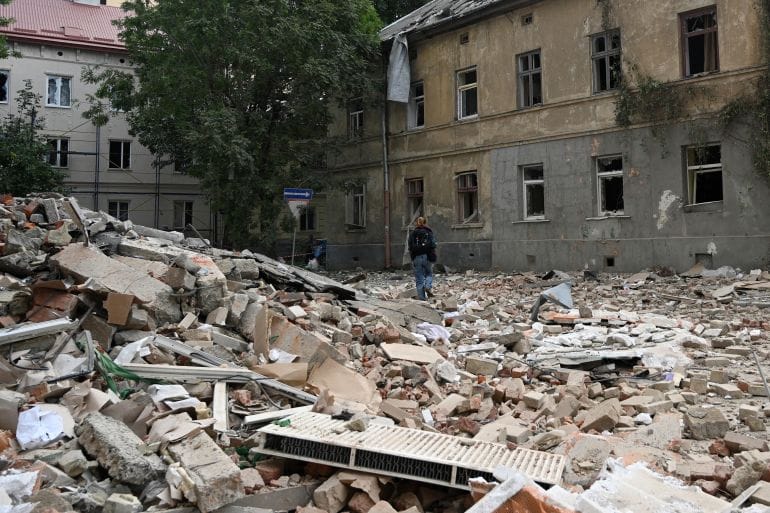
Ukrainian children play outside a tent where people can charge their devices and warm up, as Russian missile and drone strikes on Kyiv have left thousands of civilians without electricity. On Monday night, Russia launched an airstrike on Kyiv, causing a fire in one of the city’s districts, according to the Ukrainian army. Tymur Tkachenko, head of the military administration in Kyiv, reported that Ukraine’s air defense units attempted to repel the attack. Over 1,000 apartment buildings in the Ukrainian capital, Kyiv, have been left without heating approximately three days after a devastating Russian assault, as stated by Ukrainian authorities.
Ukrainian Prime Minister Yulia Svyrydenko announced on Telegram that not a single day has gone by this week without Russian attacks on energy facilities and critical infrastructure, totaling at least 44 attacks. A Ukrainian drone strike on the city of Voronezh in Russia resulted in the death of a woman and injuries to three others, stated the region's governor, Alexander Gusev. In addition, more than 10 apartment buildings, around 10 private houses, a secondary school, and several administrative buildings were also damaged in the Voronezh attack.
The Ukrainian army reported having made “direct hits” on three drilling platforms in the Caspian Sea owned by the Russian company Lukoil. The Russian Ministry of Defense claimed to have taken control of the village of Bilohirya in southeastern Ukraine's Zaporizhia region. The Ukrainian Ministry of Defense informed that Russia has deployed the “Geran-5” jet attack drone against Ukraine for the first time this month. The Geran drone is a Russian variant of the Iranian Shahed model, capable of carrying an explosive payload of 90 kg with a range of about 1,000 km.
Another significant development is military aid. The United Kingdom announced it will develop a new deep-strike ballistic missile for Ukraine under the project named Nightfall, aimed at creating missiles capable of carrying a payload of 200 kg over a distance of more than 500 km. Sweden has declared it will spend 15 billion Swedish kronor (approximately 1.6 billion dollars) on air defense, mainly to protect civilians and civilian infrastructure, continuing to bolster its forces in light of the Russian invasion.
European Commissioner for Defense, Andrius Kubilus, stated that the European Union should consider establishing a combined military force to potentially replace American troops in Europe. Kubilus, a former Prime Minister of Lithuania, emphasized that such a force, consisting of up to 100,000 soldiers, could be a viable option to better protect Europe.
In political and diplomatic news, European Commission President Ursula von der Leyen asserted that it is now up to Russia to demonstrate interest in peace, after Kyiv and its allies accepted a 20-point peace plan that would come into effect following a ceasefire. Von der Leyen specified that, according to the plan, Ukraine would rely initially on its armed forces, which are well-trained and combat-experienced. The task for Europeans will be to ensure that the Ukrainian army is also well-equipped. Von der Leyen added that the second line of defense will consist of the so-called Coalition of Volunteers - 35 states including most EU countries, Canada, the UK, Australia, New Zealand, and Turkey.