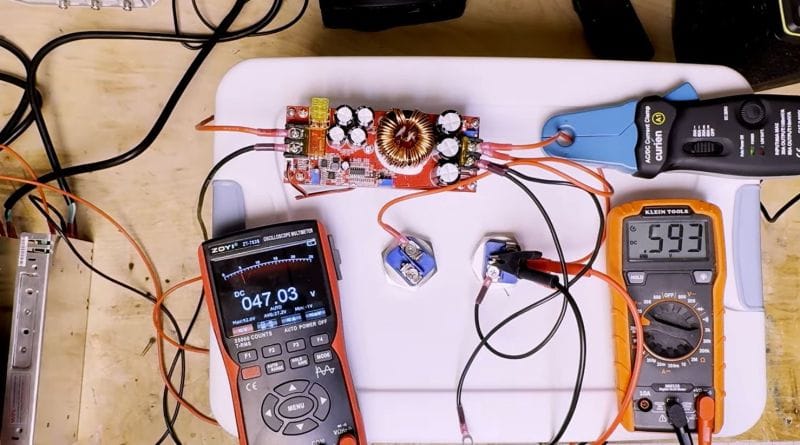
Testing a Low-Cost 1800W DC-DC Boost Converter
Introduction
Nowadays, DC-DC converters are widely available, with some low-cost models being safe for use, posing no immediate risks to users. This has sparked curiosity as we navigate various online shopping platforms, where clones of a DC-DC boost converter, such as the QS-4884CCCV-1800W, are encountered.
Performance Assessment
One important question is whether these devices can truly deliver 1800 W without an active cooling system. Josh from the [Signal Drift] channel decided to address this question. It appears that the only real "spec sheet" for this module comes from a company in Florida, which names it 36843-PS; however, the specifications are repeated in product listings from stores, suggesting that this could be considered the "official spec sheet."
Uses and Limitations
The module is intended for charging lead-acid batteries and amplifying outputs from PV solar panels, although it is advisable to use an MPPT charger for this purpose. Observations on the oscilloscope show a switching frequency of 100 kHz, with output noise ranging between 1-7 VDC, depending on the load, suggesting that the output voltage is not suitable for sensitive electronic equipment.
Circuit Analysis
On the circuit board, it can be seen that it is equipped with a PWM controller TI TL494C, which drives the MOSFETs in the boost circuit. Additionally, a buck converter XLSemi XL7005A is used for low-voltage power on the board. A dual op-amp LM358 is employed in the monitoring circuit for voltage. Although the board implements basic safety measures related to voltage and current, the documentation recommends that it should not be powered for extended periods.
Tests and Conclusions
To achieve the maximum power of 1800 W, an input of at least 48 VDC would be required. Tests conducted showed that with a 48 VDC input, the maximum power delivered was 1200 W, with the limit reached. Although the price of approximately $18 makes this module attractive, users should be aware of its limitations and avoid using it for extended durations on sensitive loads.