Lebanon Faces Dilemma as Deadline Approaches for Disarming Hezbollah
Lebanon at a Crossroads
As Lebanon's government-imposed deadline for disarming Hezbollah draws near, the group has declared it will not relinquish its weapons. In August, the Lebanese Cabinet tasked the military with formulating a plan to dismantle Hezbollah's arms by the end of 2025, following a proposal from the United States.
Hezbollah quickly dismissed this decree, calling it a "grave sin" and promising to treat it "as if it does not exist." In September, the Lebanese military presented a phased approach for disarming Hezbollah, starting from the southern region of the country down to the Litani River, which lies 28 kilometers from the Israeli border, and continuing northward toward the capital, Beirut, and eventually on a national scale. Thursday marks the deadline for completing the first phase. However, Hezbollah, with a defiant attitude, has ignored the disarmament efforts, viewing them as an American-Israeli plan requested at a time when Israel is conducting daily airstrikes on Lebanon. "Requesting exclusive control over weapons while Israel commits aggressions and America imposes its will on Lebanon means that you are not acting in Lebanon’s interest, but in the interest of those who want Israel," stated Hezbollah leader Naim Qassem this week.
Continuous Threats and Violence
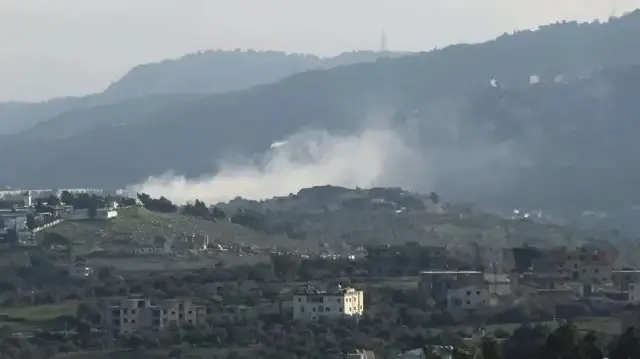
The debates in Lebanon continue regarding the exclusivity of arms being held by the state, while Israeli attacks on the country show no signs of stopping. On Wednesday, Israeli forces bombed several villages in southern Lebanon, according to the National News Agency. Furthermore, Israeli attacks have not been confined merely to the southern region of the Litani River. In November, Israel bombed Beirut and killed Haytham Tabtabai, one of Hezbollah's top leaders. Last week, an Israeli strike killed three people, including an officer of the Lebanese army, in the coastal city of Sidon, located north of the Litani. Beyond airstrikes and continual violations of Lebanese airspace by surveillance drones, Israel continues to occupy five points within Lebanon.
Complicated Decisions
Opponents of Hezbollah argue that the group has failed to deter Israeli attacks, claiming its weapons only invite new aggressions without providing significant defense. It is also argued that the Shia Muslim party should not be allowed to make war and peace decisions on behalf of an entire multi-religious country. Critics highlight Hezbollah's alliance with Iran, accusing the group of acting as a tool for Tehran's "resistance axis," rather than advancing Lebanon's interests. However, Hezbollah contends that without its resistance, Israel could occupy and build settlements in southern Lebanon, asserting that the Lebanese army is insufficiently equipped to combat such threats. The United States, Israel's closest ally, is the main source of armaments for the Lebanese army, yet in September, the U.S. special envoy Tom Barrack acknowledged that Washington does not support Lebanese armed forces to confront Israel, stating: "We do not want to arm them... to fight against Israel. I do not think that’s the case."
An Uncertain Future
Hezbollah now finds itself at a critical juncture, facing a potential new Israeli intervention, while Lebanese officials claim the army is making progress in completing the first phase of the disarmament plan. However, Hezbollah insists it will not surrender its weapons nor combat against the Israeli occupation. The risks of a new Israeli conflagration are immense, and U.S. President Donald Trump has not ruled out the possibility of renewed conflict when asked about it. "We’ll see about that," Trump remarked during a joint appearance with Israeli Prime Minister Benjamin Netanyahu in Florida. "The Lebanese government is at a slight disadvantage, considering Hezbollah. But Hezbollah has behaved unacceptably, so we’ll see what happens."