“They Can’t Break Us”: Georgians Persist With Pro-European Protests Despite a Year of Crackdowns
One year after Georgia’s pro-European protest movement erupted onto the streets of Tbilisi, nightly demonstrations continue with unwavering determination. Despite arrests, intimidation, new repressive laws, and efforts to silence critics, protesters insist that their fight for a European future will not be crushed.
A movement born out of frustration
The protests began on 28 November 2024, when Prime Minister Irakli Kobakhidze abruptly halted Georgia’s EU integration process for four years. For many Georgians, the announcement felt like a betrayal of the nation’s decades-long aspiration to join the European family.
“It’s about our future,” says 39-year-old Giorgi Arabuli, who has attended nearly every rally since the first night. “I lived through the chaos of the 1990s. I know what Russian influence brings. We won’t return to that darkness.”
From mass rallies to a battle of endurance
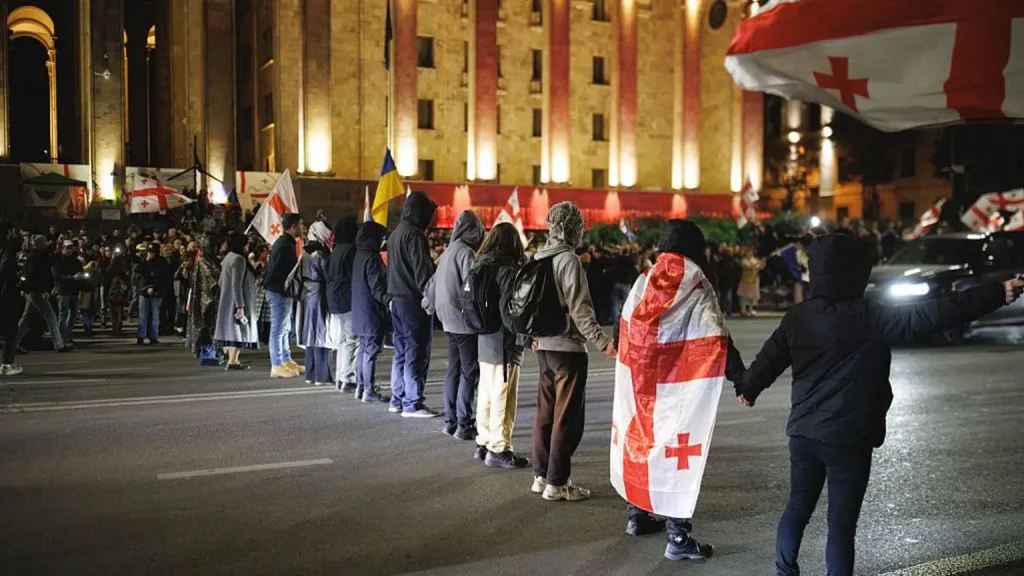
What began as huge gatherings of tens of thousands on Rustaveli Avenue has evolved into a prolonged campaign of civic resistance. As police repression intensified, protesters adapted with astonishing resilience.
Early demonstrations were met with tear gas, water cannons, rubber bullets, and hundreds of arrests. Then came the fines: enormous penalties for blocking roads. In recent months, the ruling Georgian Dream party introduced a new law — allowing up to 14 days in jail for a first offence of obstructing traffic, and up to a year for repeat offenders.
Police now clear Rustaveli Avenue within minutes of any attempt to occupy it. In response, protesters shift to side streets, forming rapid, fluid marches.
“We’ve had to change everything — routes, timing, methods,” says student activist Mariam Aptsiauri. “But they still haven’t stopped us.”
Targeting political opponents and critical voices
The crackdown has spread far beyond street protests. Several leading opposition figures have been arrested, including six high-profile politicians detained for refusing to testify before a parliamentary commission.
One of them is Zura Japaridze, who has spent months in solitary confinement. His wife, Nata Koridze, attends every rally, carrying a banner demanding “Freedom for regime prisoners.”
“He has seen no one except a doctor and a guard,” she says. “But he is not broken — and neither are we.”
Prosecutors have since filed new charges against eight other opposition leaders, accusing them of sabotage and “aiding foreign powers” — in reality, for communicating with Western diplomats about human rights abuses.
Prominent journalist Mzia Amaglobeli was sentenced to two years in prison for slapping a policeman — a charge widely deemed politically motivated. She continues to write from solitary confinement:
“Russia is conquering us without firing a shot. An oligarch controls this country, stealing our European future. We need the free world to stand with us.”
EU membership hopes in jeopardy
Georgia's progress toward EU membership has nearly collapsed. The EU’s latest enlargement report described the country as a candidate “in name only,” concluding that democratic backsliding had reached alarming levels.
EU Ambassador Pawel Herczynski delivered an unusually blunt assessment:
“Georgia is not on a path to EU membership — not by 2030, not later.”
The ruling party responded with escalating anti-Western rhetoric. Parliamentary speaker Shalva Papuashvili accused the EU of “political dictates,” claiming Brussels rejected the “real Georgian identity.”
Meanwhile, opposition parties have boycotted parliament since last year’s election, which OSCE observers noted was marred by pressure, intimidation, and voter manipulation. This has allowed Georgian Dream to pass laws unopposed, including restrictions on foreign funding for NGOs and new broadcasting regulations.
Defiance on the streets
Even after hundreds of fines and dozens of jail sentences, the nightly gatherings continue. Some are small and fast-moving; others draw thousands in spontaneous demonstrations.
“They’ve tried everything — arrests, violence, fear,” says Koridze. “But they can’t crush us. Not when the stakes are this high.”
For many Georgians, this is not just a political struggle but a defining crossroads: remain anchored to Europe, or slide back into Moscow’s sphere of influence.
And on the streets of Tbilisi, the message is clear: they refuse to give up.