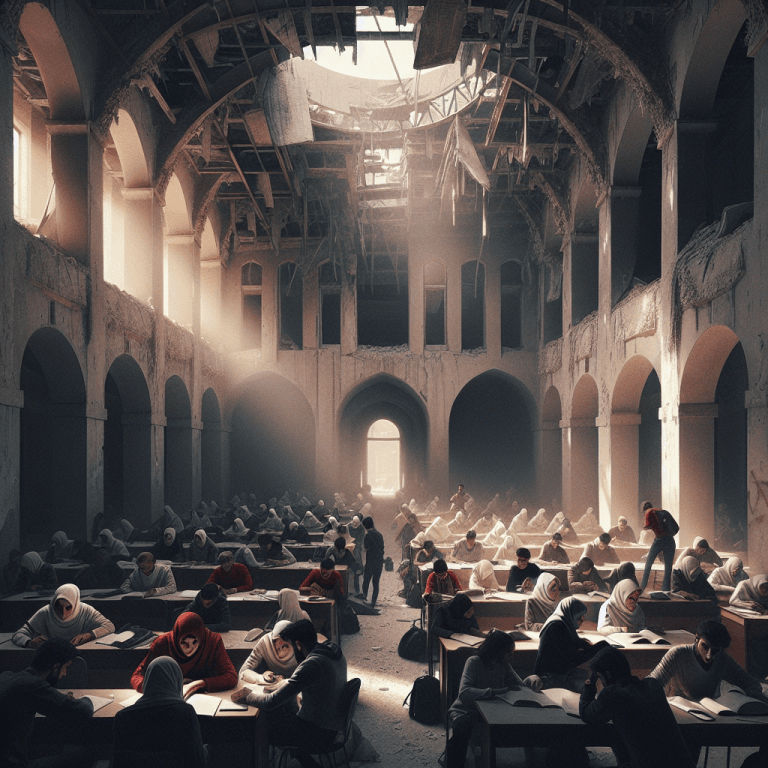
When Universities Become Battlefields: The Impact of War on Education in Iran
War and Education: A Dangerous Intersection
Recently, geopolitical tensions between Iran and American and Israeli forces have escalated alarmingly, impacting not only political landscapes and international relations but also the realm of education. Following attacks on two Iranian universities, the Islamic Revolutionary Guard Corps issued threats against American universities in neighboring countries. These events highlight how war extends its reach into areas of society that should remain untouched by armed conflict.
In recent weeks, reports indicate that over 21 Iranian universities have suffered significant damage, raising serious questions about the role of education in a military conflict context. History shows us that during times of war, educational infrastructures frequently become targets. However, the specific reasons for these attacks warrant detailed examination.
A War on Educational Grounds
Historically, education has been viewed as a fundamental foundation for the development of any society. Nevertheless, during conflicts, universities and educational institutions often become arenas for ideological and political contestation. In Iran's case, the assaults on these institutions appear to be part of a broader scheme to destabilize the regime by not only destroying physical structures but also undermining the cultural and intellectual underpinnings of society.
Compounding the complexity of the situation is the fact that universities are not merely educational venues; they serve as incubators for ideas, discussions, and, in many cases, protests. Between academic endeavors and political activism, campuses frequently nurture the upcoming national leaders. Thus, attacks on these institutions can have profound implications for a nation's ability to cultivate its citizens and tomorrow's leaders.
Military Strategy and the Instrumentalization of Education
The Islamic Revolutionary Guard Corps is no stranger to utilizing education as a propaganda tool. In the context of external threats, there is an effort to rally nationalism and anti-American sentiments, leading to increased control over educational institutions. These attacks are not merely acts of violence; they serve as a message: intellectualism and education are being crushed under the weight of war.
Paradoxically, assaults on universities may ignite a spirit of rebellion and contestation among students. This could foster a generation increasingly aware of its rights and role in society. Affected by the damage to their education, these youth may become not just witnesses to their plight but active participants in the struggle for change.
The Economic Impact on Education
The repercussions of war on education are not only physical but also economic. In a country already distressed by international sanctions, damage to educational infrastructure exacerbates an already precarious situation. Universities typically rely on government funding and external investments. With dwindling resources and a climate of instability, many students find themselves compelled to abandon their education.
The involvement of universities in war and conflict can also jeopardize international partnerships. Iranian universities, once regarded as benchmarks for higher education in the region, are now facing an increased risk of academic isolation. This isolation may result in a distortion of knowledge and access to information, undermining the intellectual growth of a nation.
The Internationalization of the War on Education
The conflict in Iran is not merely a national issue; it is also an international one. Threats targeting American universities in the vicinity suggest an escalation of the conflict, affecting many beyond Iran's borders. This dynamic introduces a new dimension into educational geopolitics, wherein battlefields are transformed into universities and professors, while academic research is undermined by threats and violence.
When a nation chooses to direct its wartime efforts towards education, it signifies that the fight is no longer solely against external foes but also against its own citizenry. This aspect becomes profoundly relevant in today’s context, where the youth may find themselves on the frontlines of a struggle that could define their future.
The Warhial Perspective
From the Warhial perspective, the unfolding events in Iran represent a tragedy not only for that nation but for the entire international community. Education should not be a battlefield; rather, it ought to be a platform for development, innovation, and progress. It is crucial for all international actors to focus their efforts on fostering a safe and nurturing educational environment rather than on destruction. In an increasingly interconnected world, the violation of the right to education has ramifications that extend beyond national borders, impacting global stability.