Devastating Impact of Iranian Rockets in Beit Awwa
A War-torn Corner: Beit Awwa and the Fragments of Destruction
On an ordinary night, the beauty and harmony of a community were shattered under the weight of a missile originating from a complex geostrategic conflict. Beit Awwa, a small town in the West Bank, became the site of a tragedy in which three Palestinian women lost their lives due to an Iranian rocket attack. This incident transcends mere statistics; it is a chronicle of profound sorrow that extends beyond the borders of this ongoing conflict.
Bitter Lessons of War
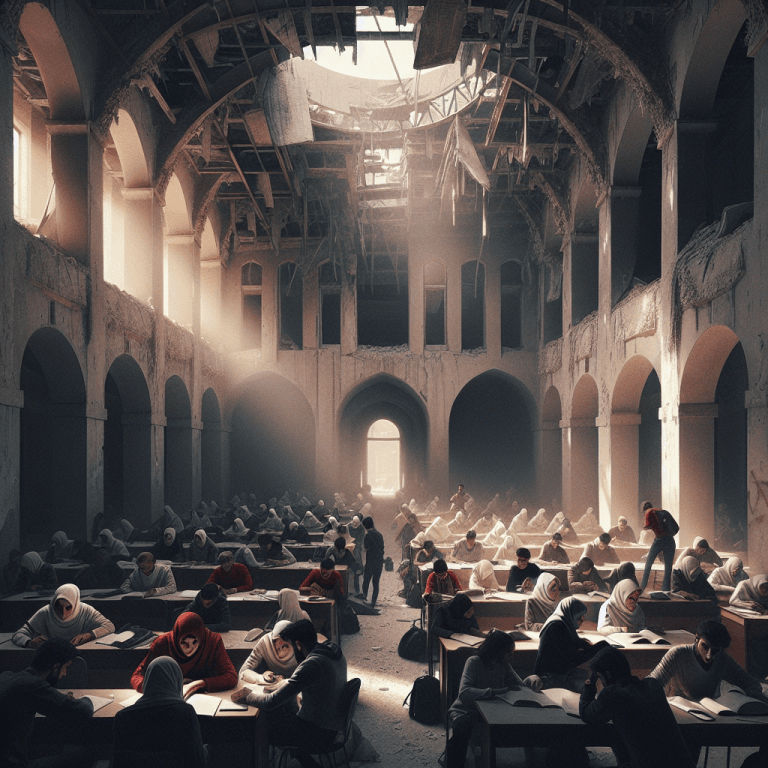
War is not merely measured in terms of territory or resources; it leaves an indelible mark on human lives. Seventeen-year-old Mais Ghazi Masalmeh, along with two older women, Sahira Rizq Masalmeh and Amal Sobhi Abdel Karim Matawa’ Masalmeh, were killed in a beauty salon—a space that symbolizes refuge and relaxation, now transformed overnight into a harrowing testament to vulnerability. The missile fragments that struck this sanctuary underscore the chaotic nature of war, where civilians fall victim to distant political and military decisions.
Technology and Inaccuracy: The Threat of Cluster Munitions
The type of rocket used in the Beit Awwa attack was a cluster munition, a controversial weapon known for its theoretical efficiency but resulting in significant civilian casualties over a wide area. These munitions, which release smaller bombs over an extensive radius, turn urban landscapes into fields of death. In theory, they could target military personnel; however, the reality is that their use in populated areas draws international condemnation and violates the rules of engagement in armed conflict.
The Human Impact of War: Beyond Statistics
The immediate response from medical services, along with the challenges faced by rescue teams, reflects another facet of war: damaged infrastructure and lack of access. The Palestinian Red Crescent Society reported that their intervention was hampered by major obstacles, such as iron gates blocking swift access to the site of tragedy. The reality that precious hours of potential rescue were lost due to administrative restrictions highlights the fragility of life in such situations. Every minute counts, and each delay may result in a life lost.
The Silent Riders: The Identity of Palestinian Women
The women who lost their lives each had stories, dreams, and responsibilities. Mais, at the cusp of adolescence, was an unfulfilled promise. Sahira, a mother, and Amal, an aunt, were pillars of support for a family devastated by grief. Palestinian women, often overlooked in narratives of war, play a crucial role in preserving daily life and community culture. Their deaths represent not just individual tragedies, but a collective loss that will leave a mark on future generations.
Electrodes of International Tensions
The Iraqi rocket attacks manifest as clear evidence of heightened international tensions within the region. Iraq and Israel are entangled in a cycle of violence that wreaks havoc on civilian populations. Each attack is a response to a long-brewing sense of hatred, yet the outcome is merely an escalation of a conflict that perpetuates suffering on both sides.
International Vision and Lack of Intervention
International reactions are often criticized for being inadequate or delayed. Organizations advocating for peace and human rights are frequently disregarded, leaving afflicted communities to bear the burden of war. Press releases and calls for dialogue lose their potency, while the day-to-day suffering remains unacknowledged by those who could enact change.
One of Humanity's Most Painful Questions
The crucial question that endures is: how can we prevent such tragedies in the future? The importance of peace education, fostering dialogue, and involving international communities becomes essential to building a future where incidents like these are no longer possible. In an interconnected world, the suffering of one affected community inevitably impacts us all.
How Can We Respond?
In the face of such painful realities, the responsibility to respond does not rest solely with those directly involved. Global societies must take an active stance, exerting pressure on governments to enact concrete and effective measures that protect civilian lives in conflict zones. Compassion must transcend national borders, and international solidarity is critical in constructing a better future.
An Open Letter to Humanity
The entire world must open a window to the harsh reality of the conflict in the Middle East. It is vital to distinguish politics from human lives. It is time for every individual to see themselves as an integral part of a single humanity, where every life deserves protection.
The Warhial Perspective
The attack in Beit Awwa serves as a stark warning for all those engaged in this cycle of violence. This incident represents more than an individual tragedy; it reflects a profound humanitarian crisis that requires a more empathetic approach. In closing, the question arises: will humanity ever succeed in overcoming prejudice and self-interest to build a future where such tragedies are no longer conceivable? Without a paradigm shift, we will continue to mourn losses without learning from history.