Artful Bridges Over Aleppo’s Ruins: Creativity and the Reconstruction of Trust
Fragile Scenes Between Neighborhoods Divided by the Frontline
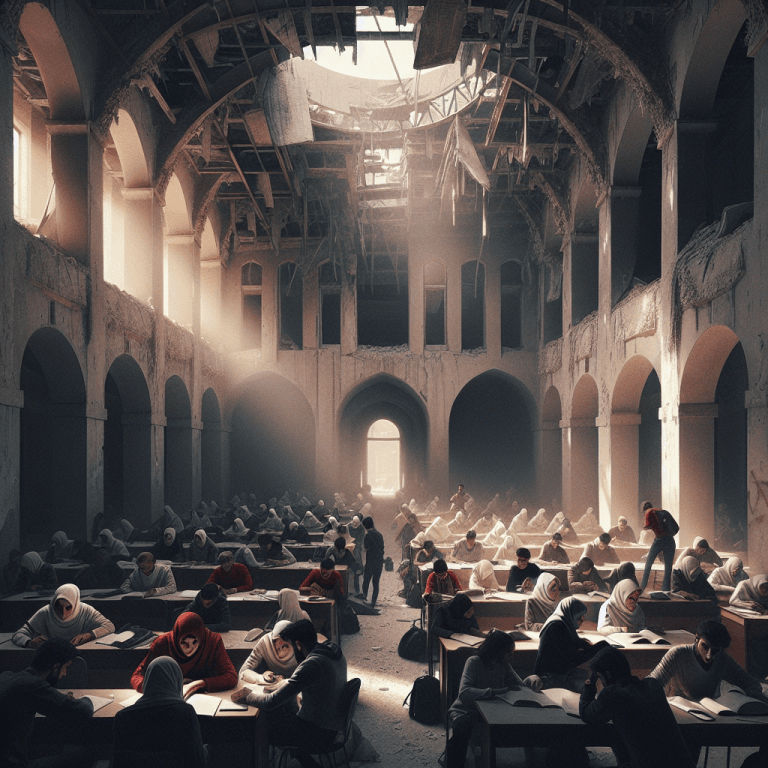
In a city marked by scars—shattered buildings, streets still pocked with bullet holes, and communities displaced or divided by lines of conflict—a collective of artists is quietly reopening doors that war had slammed shut. The cultural initiatives emerging in Aleppo, recently documented by international media, are not harmless aesthetic diversions: they are social experiments that deliberately bring together people who, until recently, feared crossing into one another’s neighborhoods. Painting workshops, impromptu concerts and outdoor film screenings have become practical tools for rebuilding trust in places where trust has grown scarce and costly.
Art as Neutral Ground, but Not Politically Neutral
Cultural spaces often function as neutral terrain: an atelier does not require adherence to a political creed, and a stage does not demand a confessional identity. Yet in a fractured city neutrality can be an illusion. Even the choice of a theme, a tune or an image can be read as a political stance. Artists in Aleppo must therefore balance their creative mission with local pressures—from authorities who scrutinize any public gathering to communities that define themselves through shared suffering. This ambivalence turns a workshop into a miniature political process: creative, therapeutic and civic at once.
Encounters That Reconfigure Trust
The core premise of these initiatives rests on contact theory: regular, goal-oriented encounters reduce mutual prejudice. In Aleppo the shared objective is concrete and effective—not enforced reconciliation but the co-creation of a common object: a theatrical piece, a mural or a community film that incorporates contributions from different groups. Through this collaborative act, participants reclaim a shared space of memory where individual narratives intersect without being reduced to simplistic roles of victim and aggressor.
The psychological impact is tangible. Organizers describe moments when people, for the first time in years of suspicion, laughed together, listened to the same song and spoke outside the rituals of political performance. These small, human interactions do not rewrite geopolitics, but they restore the social routines that make public life possible: shared streets, shared events and the informal exchanges that sustain civic life.
Why This Is More Than Therapy: Culture, Economy and Memory
Cultural projects are not only about individual healing. They generate economic opportunities—performances, art sales and modest cultural tourism—and they restore access to public space. Crucially, they shape how recent history is remembered. Local cinema, in particular, gives communities a platform to tell their own stories, offering a counterweight to dominant narratives imposed either by the state or by former de facto opposition leaders. In this way culture becomes an arena for negotiating memory as well as meaning.
Risks That Can Turn Bridges into Traps
Significant risks remain. In a volatile security climate, authorities can abruptly curtail activities or exploit cultural events to legitimize particular policies. External funding—essential for the survival of many collectives—often arrives with its own agenda: donor organizations may request certain themes, partners or reporting that undermine artistic autonomy. There is also the danger of co-optation: artists may unknowingly become mouthpieces for official narratives, or, conversely, be marginalised if they adopt an overtly critical stance.
Beyond political pressure, social barriers are real. Many initiatives are dominated by educated youth or members of an urban middle class; elitism is therefore a persistent risk. For art to serve as a genuine social bridge, access must be broadened—to women, the elderly, internally displaced persons and marginalized minorities—so that cultural spaces reflect the heterogeneity of the city they aim to reconnect.
Metrics for Success and Evaluation Methods
Evaluating cultural impact is essential if projects are to be scaled. Traditional indicators—attendance numbers, event frequency—are useful but insufficient. Effective measurement combines quantitative and qualitative methods: pre- and post-participation surveys on intercommunity trust, in-depth interviews with participants, and ethnographic studies tracking shifts in neighborhood dialogue. Visual documentation and digital archives serve both as evidence and advocacy tools, useful for political lobbying and for attracting sustainable funding.
Relations with Humanitarian Organizations and Local Authorities
Partnerships with large NGOs can supply logistical resources and mental-health expertise, but they demand transparency. Cultural actors must retain narrative control: defining themes, selecting participants and safeguarding confidentiality. Simultaneously, engaging with local authorities can legitimize initiatives and offer a degree of protection. The balance is precarious: too close an alignment with power erodes credibility among traumatized communities, while total isolation limits reach and scalability.
Workshops, concerts and screenings are more than events: they are pragmatic attempts to rewrite social relations in a city that has learned to live in fear. But bridges do not stand without foundations—security, independent funding and an inclusion strategy.
Strategies for Sustainability
To convert artistic initiatives into durable social infrastructure requires three priorities: diversified funding, professionalized cultural management and the integration of psychosocial services. Funding diversity means combining local grants, modest audience contributions and partnerships with the diaspora. Professionalization entails training in cultural management, legal protections for artists and safety protocols at events. Integrating psychosocial support calls for collaboration with psychologists, training in basic mental-health first aid and clear referral channels for participants in distress.
What Long-Term Success Looks Like
Success will not be measured solely by the number of murals painted or films screened, but by the quality of reconstructed public relationships: neighbors who again claim communal spaces, civil organizations cooperating across confessional lines, and a younger generation learning to express disagreement without resorting to violence. In cities such as Aleppo, cumulative small changes can shift the social climate more effectively than isolated grand gestures. Sustained success depends on embedding cultural work in everyday life—schools, markets and local councils—so that arts-based trust-building becomes part of routine civic practice.
The Warhial Perspective
Artistic initiatives in Aleppo testify to a remarkable cultural resilience: they demonstrate that, even in the absence of broad political consensus, people can create micro-worlds of trust. That resilience, however, has limits. Regional authoritarian tendencies, geopolitical interests, narratives of victimhood and the lack of robust legal protections can reduce cultural bridges to temporary fixes, easily eroded by spikes of violence or shifts in funding priorities. Warhial’s prognosis is therefore cautious: over the next three to five years we can expect a proliferation of cultural initiatives responding to communal needs, but only a subset will outlast episodic funding and windows of relative stability. The difference-maker will be the consolidation of autonomous local networks, strengthened managerial capacity and a policy of support—partnership rather than paternalism—by civic actors and funders willing to accept imperfect processes. If support remains concentrated on high-profile projects, impact will be limited; if investment focuses on foundations—people, training and decentralized cultural infrastructure—art could become one of the few viable instruments for resilient social reconstruction in Aleppo.