Flames Over Gul Plaza: Why Karachi Has Once Again Lost Safety in Its Marketplaces
A nightmare night in the heart of Karachi's commercial life
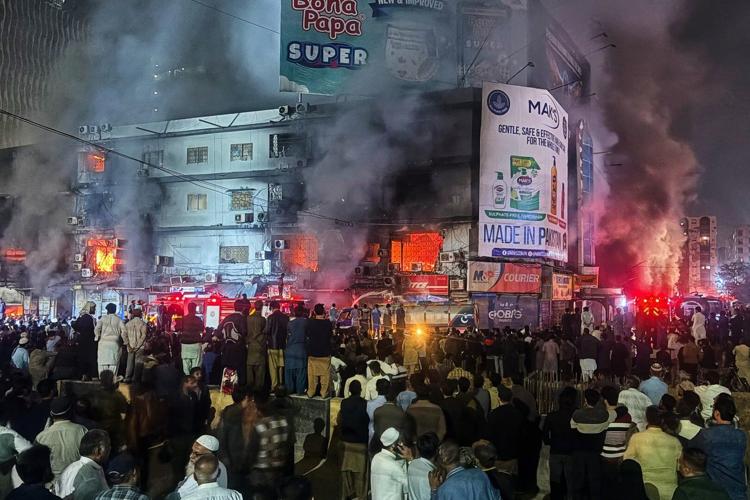
The fire that consumed Gul Plaza rapidly transformed a once-vibrant commercial hub into a smouldering expanse of ruins. The eight-thousand-square-metre complex, housing roughly 1,200 shops, ignited in the evening hours and resisted full containment for more than 24 hours. The provisional toll—eight dead, including a firefighter, dozens injured and at least 58 people reported missing by family members—represents only the visible portion of the catastrophe. Shopkeepers who watched helplessly as their inventories were incinerated recount the same story: merchandise reduced to ash before it could be moved, friends and colleagues unaccounted for, phones that never rang back. The scene exposes how daily commerce and human lives are exposed to acute risk when safety mechanisms fail.
Highly flammable materials and an airless labyrinth
Rescue teams have offered a blunt technical explanation: the presence of foam plastics, textiles and perfumery products accelerated the fire’s spread. These items, ubiquitous in small retail outlets and adjacent storage rooms, act like time bombs when basic storage and prevention measures are disregarded. Beyond the combustible goods themselves, inadequate ventilation and narrow corridors turned the building into a furnace: dense smoke and oxygen-deprived spaces rendered orientation and rapid rescue operations all but impossible. In such conditions, heat and toxic fumes become the greatest killers, often before structural collapse occurs.
Access for rescuers — racing against a failing structure
Structural failure compounded the rescue challenge. Large sectors of the mall collapsed or were deemed at imminent risk of collapse, forcing rescuers to weigh difficult choices: slow, manual entry to search for survivors versus the deployment of heavy machinery that might precipitate further collapse. Coordination centres set up registers for the missing; relatives waited among the debris with identities in hand and fragile hopes. Where mortuaries and forensic procedures are insufficiently equipped, the process of identifying victims can become prolonged and deeply traumatic, generating administrative bottlenecks and human suffering. The arithmetic of rescue in these circumstances is painfully simple: every minute lost and every barrier encountered costs lives.
A culture of impunity: rules on paper, lax enforcement in practice
President Asif Ali Zardari ordered a review of safety measures across commercial and residential buildings in Sindh—an unsurprising political response to a public emergency. Yet the core problem lies not in the absence of regulations but in their non-implementation. As in many rapidly growing cities, building codes and fire-protection standards often exist primarily on paper. Inspections are intermittent, compliance certificates can be acquired through patronage, and interior alterations—partitioning, improvised storage, blocked emergency stairways—become de facto arrangements. Owners, market managers and local authorities may exchange responsibilities, but they rarely pay the price for systemic negligence. The consequence is a persistent gap between regulation and reality, which leaves urban populations vulnerable to recurrent disasters.
The informal economy and hidden risks
Gul Plaza functioned as more than a shopping complex; it was an economic ecosystem sustained largely by the informal sector: small boutiques, oversized backroom inventories and makeshift workshops. In a commerce model where profit is calculated per square foot, storage becomes overcrowded and flammable stock is often kept dangerously close to potential ignition sources—exposed electrical wiring, welding equipment, improvised lighting and heating devices. The hazard is magnified by the absence of standardized detection and suppression systems: automatic sprinklers, functioning internal hydrants and outward-opening fire exits. Without these safeguards, a single spark can escalate into a community-level catastrophe.
Emergency response: resources, training and operational priorities
The Gul Plaza operation mobilised local teams—Rescue 1122 and municipal fire brigades were at the forefront—and revealed capability gaps. Essential equipment, high-access firefighting capacity, thermal imaging technology and specialized evacuation apparatus remain insufficient in many urban centres. Continuous training for first responders, mandatory evacuation plans for large commercial buildings and coordinated drills with police and medical services are not administrative luxuries; they are frontline barriers against death and destruction. Investment in these capabilities reduces the likelihood that a contained incident becomes an existential crisis for a neighbourhood.
Public accountability or political ritual?
Any official inquiry must answer straightforward questions: how were such materials allowed to be stored under those conditions, what did prior inspection reports show, who issued safety certificates and what became of them? Historically, investigations have produced impressive reports that rarely translate into lasting accountability. There is a real risk that this tragedy, like previous ones, will be followed by symbolic gestures—donations, pledges of review and occasional fines—without structural reform. If responsibility is not enforced and preventative measures institutionalised, similar incidents will recur, imposing human and economic costs that outstrip any temporary political advantage.
"My shops were burning before my eyes. We couldn't even get the goods out of those shops. There are still many people inside, I have many friends who are out of contact," said one affected trader, capturing the despair of those trapped in the inferno.
Paths toward effective prevention
Prevention is not a set of governmental declarations but a coherent package of technical, administrative and social interventions. Mandatory, periodic independent inspections and the requirement to install automatic suppression systems in large commercial properties should be standard. Compliance incentives—such as tax breaks for certified buildings—and penalties for violations must be enforced. Compulsory first-aid and evacuation training for staff, clear standards for the storage of flammable goods and robust sanctions for non-compliance are part of the solution. Over time, addressing the informal economy’s pressures is also necessary: offering fiscal incentives and affordable, regulated commercial spaces would reduce the incentives to store goods unsafely. Real prevention requires aligning incentives, capacity and enforcement.
Social impact: material losses and collective trauma
Beyond casualties, the fire obliterates livelihoods for hundreds of families. Small shops often represent the sole income source for households without social protection, and material losses quickly translate into indebtedness, economic insecurity and forced migration. Psychologically, the community experiences collective trauma: eroding trust in institutions, diminished faith in the state’s capacity to protect, and heightened social unrest if responses are opaque or inadequate. Unless relief is transparent, rapid and accompanied by structural reforms, the social consequences may deepen inequality and fuel long-term grievance.
The Warhial Perspective
The Gul Plaza tragedy is not an isolated accident but a symptom of long-standing institutional failures. Karachi’s density and economic dynamism both sustain livelihoods and feed systemic vulnerabilities: crowded markets, regulatory circumvention and authorities who too often react after catastrophe rather than prevent it. The death of a firefighter among the victims raises acute questions about the equipment and protection afforded to first responders. If the presidential review yields only reports and declarations, the city will likely confront further tragedies in the coming years. Meaningful change requires a mix of public pressure, legislative reform and capital investment—including from international actors financing urban development—to make safety standards both enforceable and verifiable. Warhial anticipates that, absent a comprehensive and transparently executed response, the next months will bring either symbolic purges of responsibility or prolonged struggles by victims’ families for justice and compensation. Repetition is avoidable, but only if political will, independent oversight and committed resources converge to implement substantive reforms.