Tariff as a Weapon: Trump’s Threat to Europe and the Stakes for Greenland
A tariff strike proclaimed from the podium
The announcement by U.S. President Donald Trump that he would impose a 10 percent tariff from February 1, rising to 25 percent from June 1, on eight countries that opposed an American proposal to purchase Greenland was more than an exercise in fiscal arithmetic. It was a deliberate conversion of diplomatic pressure into a direct economic instrument intended to compel traditional allies to accept a proposal that runs counter to the wishes of the sovereign state and the island's population. The coordinated reaction from Denmark, Finland, France, Germany, the Netherlands, Norway, Sweden and the United Kingdom underscored the seriousness of the crisis: European Union members and Nordic states closed ranks, characterizing the threat as an act of coercion and an attempt at blackmail.
Tariffs as a foreign-policy tool: precedents and perils
Employing customs duties as a lever of foreign policy is not a novel practice, but the scale and context of this episode make it exceptional. Rather than pursuing established diplomatic or legal channels to contest Denmark's refusal to negotiate the sale of part of its autonomous territory, the White House chose a blunt economic threat. This form of coercive diplomacy produces two immediate effects: an escalation in political tension and an increased probability of reciprocal economic consequences that could spiral into a broader trade war.
European responses have not been limited to rhetoric. Officials discussed retaliatory tariffs estimated at up to €93 billion and the activation of the Anti-Coercion Instrument (ACI) adopted in 2023, a mechanism designed to counteract economic coercion by enabling restrictions on foreign investment and, in extreme cases, adjustments to intellectual property protections for companies deemed complicit in coercive behavior. If mobilized against American firms, the technical and legal fallout could be significant, marking the first major use of a tool expressly created to respond to economic coercion between advanced economies.
Greenland is not for sale: local sovereignty at the forefront
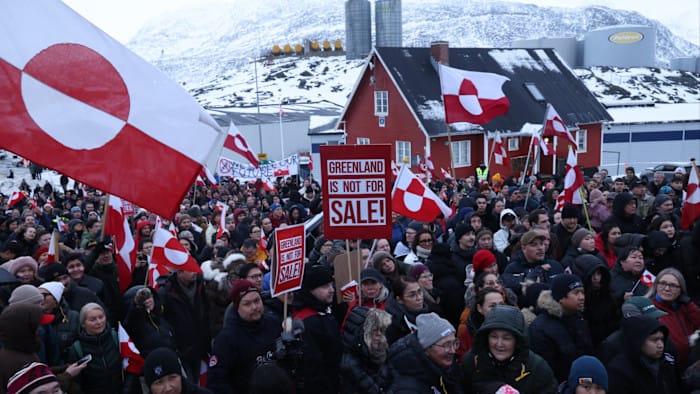
Greenland, with roughly 57,000 inhabitants, is a semi-autonomous constituent of the Kingdom of Denmark. It is not a bargaining chip to be transferred between capitals. Copenhagen's rejection of the U.S. proposal reflected not only deference to the islanders' preferences but also international legal norms that make the forcible sale of a territory against the will of its population extremely problematic. Local polls and large demonstrations in Nuuk and Danish cities, under banners such as 'Hands off Greenland', emphasize that the American initiative struck at issues of identity and self-determination as much as at geopolitics.
Any suggestion that Greenland could be treated as a transactional commodity misunderstands the nature of sovereignty and risks inflaming nationalist sentiments across the region. The insistence on local consent is both a legal reality and a political necessity; ignoring it would reverberate far beyond the immediate dispute.
NATO under strain: solidarity or schism?
The most sensitive geostrategic consequence of the episode is the damage to transatlantic cohesion. Threatening to use force to 'acquire' territory associated with an allied sovereign state, and leveraging economic ties to punish NATO members, reveals a transactional logic that undermines the alliance's foundational purpose. NATO depends on reciprocal trust and the principle that aggression against one member is aggression against all. Even the insinuation that force could be applied to a unit of another sovereign state, or that economic pressure could override allied sovereignty, casts a long shadow over the notion of collective security.
While the formal procedures and structures of the Alliance remain intact for now, erosion of trust can have durable consequences: reduced intelligence sharing and military cooperation, strategic recalibrations in Europe, and an accelerated political push toward greater European strategic autonomy. The firm, multipronged political reaction in Brussels and capitals across the EU signals that members are unwilling to normalize coercion as an acceptable negotiating tactic among allies.
Economy at a crossroads: who will pay the price?
A protracted tariff confrontation would inflict damage along global value chains. Targeted retaliatory measures amounting to €93 billion would strike key sectors, while activation of the ACI could disrupt capital flows and curtail technology transfers. In such a scenario, American firms with deep exposure to European markets would likely face material losses; consumers on both sides of the Atlantic should expect higher prices and diminished choices. Economists warn that trade disputes rarely remain localized: supply-chain disruptions, reduced investment, and increased market volatility would produce multiplier effects and a sizeable economic bumerang.
Smaller suppliers and manufacturers, whose margins are already thin, would be disproportionately affected. The political fallout could also tilt investment decisions, accelerating onshoring or diversification away from contested partner markets — a strategic economic realignment with long-term consequences for global production networks.
Why Washington eyes Greenland: resources, bases and Arctic prestige
American interest in Greenland is not merely symbolic. The Arctic has risen in strategic prominence: it offers new maritime routes, mineral deposits, potential hydrocarbon reserves, and locations for military facilities that control air and sea passages in the North Atlantic. For Washington, a direct foothold in Greenland would enhance power projection in the Arctic at a time of heightened competition with Russia and growing Chinese interest in polar regions.
Yet national-security rationales do not erase the political and normative costs of attempting to override another people’s sovereignty. Even among allies, the perceived instrumentalization of security arguments to justify territorial acquisition risks alienating partners and undermining informal rules that have governed Western interactions for decades.
The living dialectic of power: a dangerous precedent
If a tariff threat of this kind goes unchallenged, it risks normalizing coercive practices on the international stage. Other states might emulate the approach, employing economic pressure as a regular instrument to extract geopolitical concessions. The European response — unified and legalistic — is an attempt to interrupt that trajectory and to reaffirm negotiation frameworks rooted in international law and diplomatic engagement rather than economic duress.
At stake is not only the immediate policy dispute but the preservation of predictable, rule-based behavior among advanced democracies. Allowing economic coercion to become an accepted tactic would incentivize reciprocity and instability, eroding longstanding mechanisms for conflict avoidance and resolution.
The Warhial Perspective
The tariff confrontation initiated by Washington and the subsequent European countermeasures mark the beginning of a phase in which transactional norms and multilateral institutions will be tested, perhaps to breaking point. From our vantage point, the United States pursued a course that combined domestic political calculation with a competitive geopolitical outlook. Europe’s reaction — characterized by cohesion, reciprocal threats and the invocation of legal tools — is both symbolic and pragmatic. Practically speaking, an open confrontation can still be avoided only if Washington retreats from coercive rhetoric and all parties return to sustained diplomatic engagement. However, stakeholders should prepare for a period of cooled transatlantic relations, the likely activation of the ACI, and tangible economic costs for American firms with significant European exposure.
In the medium term, Greenland remains invaluable first and foremost to its residents and to Denmark; it will not be traded without their consent. Politically, this episode will accelerate two observable trends: the European Union will deepen efforts to build strategic autonomy, and states will increasingly view economic interdependence as a potential instrument of pressure. The most probable outcome is a mutual de-escalation of explicit threats in the face of reciprocal sanctions, accompanied by a shift to a more competitive, less transparent regional posture in the Arctic.