Deadly Protests Erupt in Syria Amid Sectarian Tensions
Protests Erupt in Syria
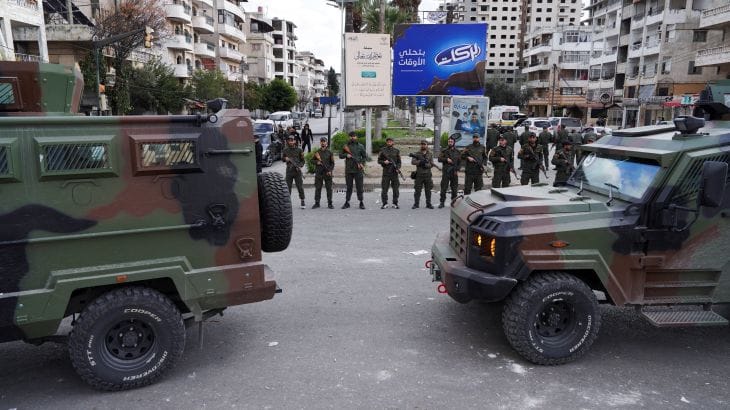
Protests have erupted in Syria's coastal regions, marking a new wave of sectarian unrest following the ousting of Bashar al-Assad's regime a year ago. During Sunday’s protests, gunfire was directed at Syrian security forces in the al-Azhari area of Latakia, while unidentified attackers threw a grenade at the al-Anaza police station in the Banias district of Tartous governorate.
The Alawite minority, to which al-Assad belongs, organized the protests after at least eight individuals were killed in a bomb attack on an Alawite mosque in Homs on Friday. They are demanding security guarantees and political reforms. Several cities along Syria's Mediterranean coast have experienced deadly sectarian violence over the past year, raising questions about the interim government’s ability to maintain unity in a nation still scarred by 14 years of civil war.
What Sparked the Protests?
The attack on the Imam Ali bin Abi Talib mosque in the Wadi al-Dahab neighborhood of Homs during Friday prayers triggered these demonstrations. The attack was claimed by a little-known group named Saraya Ansar al-Sunna, which declared on its Telegram channel that the assault was aimed at members of the Alawite sect. Al-Assad's regime has dominated Syria’s security and political structures, and Saraya Ansar al-Sunna had previously claimed responsibility for a suicide attack on a church in Damascus in June, resulting in at least 20 deaths.
Who is Leading the Protests?
The protests have been primarily organized following calls from Ghazal Ghazal, an Alawite religious figure living outside Syria, whose current location is unclear. He leads a group called the Supreme Islamic Alawite Council in Syria and abroad. “We want political federalism... We want to determine our own fate,” Ghazal stated in a video message on Facebook, referring to a system of governance where power is shared between the national government and its states.
Protesters have also called for greater protections for the Alawite community, accountability for attacks on civilians, and political guarantees. In the coastal areas, including the cities and governorates of Latakia and Tartous, clashes have occurred between Alawite protesters and counter-protesters supporting the new government. An Al Jazeera correspondent in Latakia reported counter-protesters throwing stones at Alawite demonstrators, while a group of protesters assaulted a counter-protester who entered their area.
Were There Casualties?
SANA, the official news agency of Syria, reported that four people were killed and over 100 injured in the unrest in Latakia. Citing officials from Syria's Health Directorate, SANA stated that the injuries included “stabbings, stone throws, and gunfire directed at both security personnel and civilians.” Later on Sunday, the Ministry of Interior reported that one security officer was killed in the clashes.
Who Are the Alawites?
The Alawites are a religious minority in Syria, constituting the country's second largest religious group after Sunni Muslims. They represent 10% of Syria's 23 million people, but this community has been politically dominant under al-Assad's leadership, which began in 2000. Since al-Assad’s ousting, Syria has faced multiple instances of sectarian violence.
Interim President of Syria, Ahmed al-Sharaa, emphasized the need to “preserve national unity and internal peace.” At the Doha Forum, al-Sharaa noted that the people of Syria “simply do not know each other well,” due to the challenges inherited from al-Assad's regime. The enduring sectarian divisions in Syria and the limited authority of the central government fuel minority demands for decentralization. What will happen next? In the coming days, two possible outcomes may emerge—either a temporary understanding between the Syrian government and the Syrian Democratic Forces (SDF), or an escalation of violence that could lead to deeper ethnic and sectarian divisions.