Kosovo's Government Party Secures Election Victory After Political Stalemate
Decisive Win for Vetevendosje
The Albanian nationalist party Vetevendosje has achieved a landslide victory in Kosovo's parliamentary elections, according to preliminary results. With 90% of votes counted, the party, whose name means "self-determination," has garnered 50.8%, marking a third term for its leader, Albin Kurti. The two main opposition parties, the Democratic Party of Kosovo (PDK) and the Democratic League of Kosovo (LDK), received 20.98% and 13.89%, respectively.
Vetevendosje had previously won elections in February but lacked a majority, leaving Kosovo without a functional government during this period. A major question leading up to these elections was whether voters would punish Kurti for months of stagnation in the National Assembly or whether the opposing parties would face backlash for opposing a coalition with his leftist movement. The electorate has provided a clear response.
While this victory does not guarantee Kurti enough seats to govern without coalition partners, he should not struggle to find support among the ethnic minority legislators, who are allocated 20 of the 120 seats in the National Assembly.
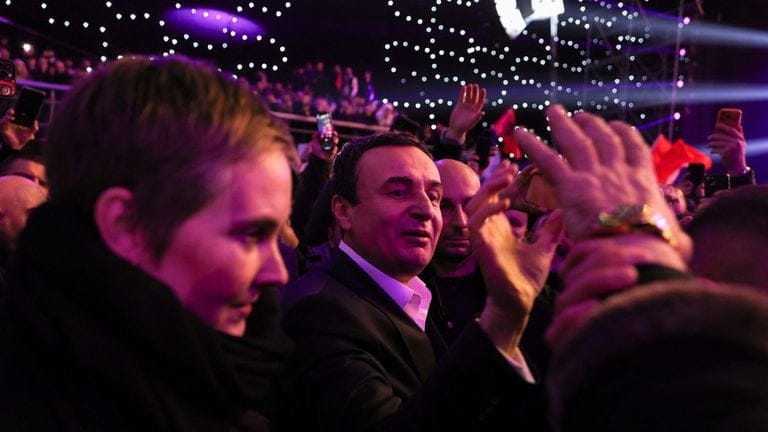
This marks the fourth consecutive victory for Vetevendosje in parliamentary elections. The result validates Kurti's position after opposition parties blocked his attempts to form a government following the previous election on February 9. Kurti stated that this is "the greatest victory in the history of the country" and expressed hope that the opposition parties would cooperate rather than sabotage efforts.
Arben Gashi from the Democratic League of Kosovo (LDK) suggested that cooperation might be possible. "When voters speak, the result cannot be ignored," he posted on social media. "Reflection and responsible action are necessary," he added.
There is much at stake. Kosovo has lost hundreds of millions of euros in European Union funds due to the lack of a functional government. Kurti has also mentioned potential agreements with the World Bank, which could raise the total funding above 1 billion euros. Repairing relationships with Kosovo's strongest international supporters, the EU and the USA, should also be on his agenda.
Kurti has strained relations with Brussels and Washington by repeatedly targeting institutions that serve the Serbian minority in Kosovo. This has heightened tensions in northern Kosovo, where the majority population is Serbian. The EU ultimately agreed to lift punitive measures imposed in 2023 but will expect Kurti to adopt a pragmatic approach in the delayed normalization dialogue with Serbia.
Given his frosty relationship with Serbian President Aleksandar Vucic, this may be an unrealistic hope. The fact that voters in Kosovo supported such a polarizing figure reflects their views on the alternatives. Parties associated with the Kosovo Liberation Army have dominated governance in the decade following the unilateral declaration of independence in 2008 but have failed to deliver on promises of prosperity.
Analyst Artan Muhaxhiri noted the "numerous violations of the constitution, lack of economic development, and deterioration of relationships with allies" throughout Vetevendosje's years in power, concluding that "despite all deficiencies, citizens perceived the opposition as more detrimental."