Denmark and Moldova: A Strategic Partnership for Security and European Future Amid Russian Hybrid Threats
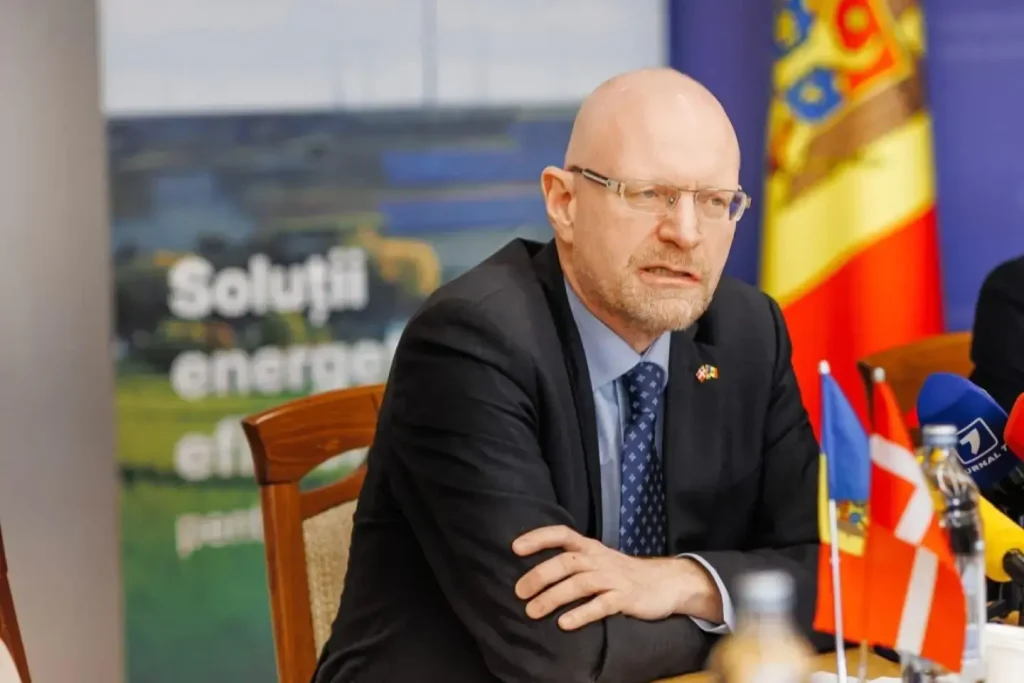
In a Europe marked by instability and the ongoing war in Ukraine, Denmark is reaffirming its unconditional support for the Republic of Moldova, intensifying bilateral cooperation in both the military and European integration spheres. In an extensive interview with Veridica, the Ambassador of the Kingdom of Denmark to Chisinau, Søren Jensen, detailed the priorities of the Danish EU Council Presidency and highlighted the urgent need for Moldova to strengthen its resilience against hybrid aggression orchestrated by the Russian Federation.
Hybrid Warfare and the "Sphere of Influence"
Ambassador Jensen provided a stark assessment of the security situation, warning that Moscow has not abandoned its imperial ambitions. "Russia continues to destabilize countries, including the Republic of Moldova, which it still views as part of its sphere of influence," the diplomat stated. According to him, had the initial plans of the Russian invasion of Ukraine succeeded, Moldova risked becoming a satellite state.
However, the Danish official praised Chisinau's ability to handle these pressures. Referring to recent electoral cycles, Jensen noted that Moldova has become an example of resilience, successfully limiting the impact of massive disinformation and manipulation campaigns. "In many respects, the Republic of Moldova is somewhat of a leader in this process of combating hybrid threats, and we can learn from it," the ambassador emphasized.
Military Cooperation: The 2025 Memorandum and Debunking Myths
A central point of the interview was the deepening of defense relations. Søren Jensen announced a memorandum of understanding between the two states, set for implementation in 2025. This agreement does not aim at the "militarization" of Moldova—a false narrative intensely promoted by Russian propaganda—but rather at aligning with Moldova's National Security Strategy.
The program includes:
-
Military training for Moldovan personnel, including the Military Police;
-
Development of cyber defense capabilities and IT laboratories;
-
Crisis management and provision of civil protection equipment (such as fire trucks);
-
Support for the voluntary participation of Moldovan soldiers in international missions.
To ensure the success of this partnership, a Danish military attaché has already been stationed in Chisinau. Her role is to coordinate directly with the Ministry of Defense and the Military Academy to implement projects and identify the specific needs of the national army.
Neutrality Does Not Mean Defenselessness
Addressing the sensitive topic of constitutional neutrality, Ambassador Jensen dismantled the myth that a neutral state must be a weak state. Citing the example of Switzerland, he explained that neutrality actually imposes an even greater responsibility to possess one's own defense capabilities, as the state does not benefit from the automatic protection of a military alliance like NATO.
In the context of recent incidents involving Russian drones crashing on Moldovan territory, the diplomat pointed out that while Denmark and NATO partners can provide support through equipment and expertise, the political decision and technical capacity to shoot down hostile targets belong to the authorities in Chisinau.
European Integration: Technical Negotiations and Crucial Reforms
As the country holding the EU Council Presidency, Denmark is making efforts to maintain the pace of Moldova's accession to the bloc. Although the formal opening of negotiation chapters has faced political obstacles at the EU level, Jensen assured that, in reality, "the chapters are practically already open" at a technical level.
He insisted that justice reform remains the "keystone" of the entire process. Without a clean judicial system, economic development and foreign investment are stalled. The diplomat also highlighted remarkable progress in the energy sector, where Moldova has succeeded in eliminating its historical dependence on Russian gas and connecting to the European electricity grid.
Conclusion
The message from Copenhagen is one of solidarity and pragmatism. Whether it is energy security, cyber defense, or the European path, Denmark remains a faithful ally of the Republic of Moldova, helping it to finally exit the "grey zone" and consolidate its place in the family of European democracies.