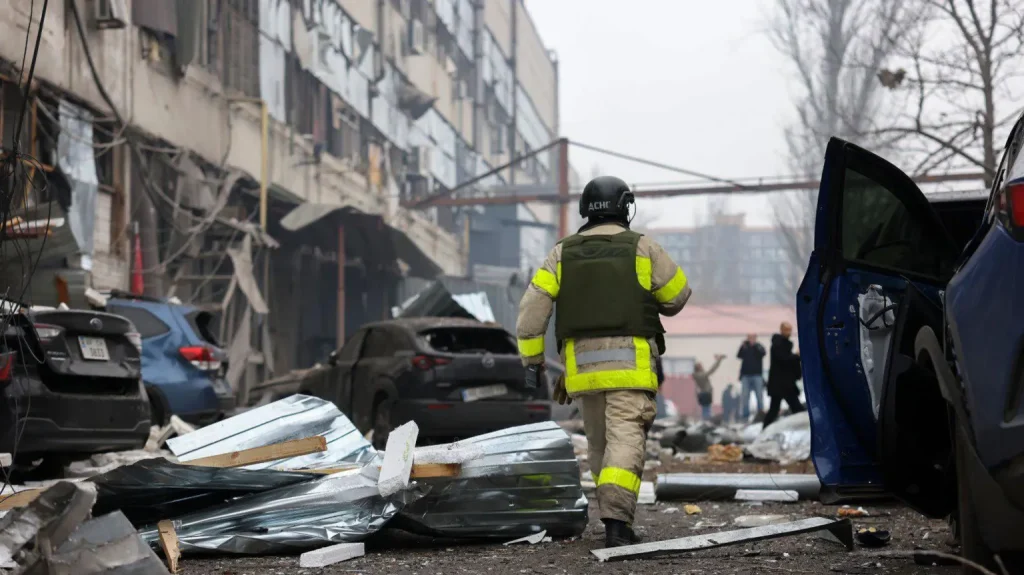
Four Killed in Russian Strike on Dnipro as Diplomatic Efforts to End the Ukraine War Intensify
A devastating Russian missile strike on the Ukrainian city of Dnipro has killed four people and injured at least 40 others, Ukrainian authorities reported on Monday. The attack, which occurred in broad daylight along a busy roadside, sent a large explosion ripping through an office building, shops, and parked cars. Videos shared online captured the moment a massive fireball erupted, throwing debris into the air and sparking panic among onlookers.
Local media reported — though not yet formally confirmed — that the weapon used may have been a ballistic missile, suggesting a deliberate choice of a high-impact strike. Dnipro lies approximately 100 km (62 miles) from the front line and has been a frequent target of Russian attacks since the full-scale invasion began in February 2022.
Strike Coincides With Key Diplomatic Mission
The deadly attack came just one day before US special envoy Steve Witkoff is scheduled to meet President Vladimir Putin in Moscow for the latest round of talks aimed at ending the war. Witkoff, a businessman and close Trump ally, has made several trips to Moscow this year — but notably has never traveled to Kyiv in his diplomatic role.
On Sunday, a Ukrainian delegation met Witkoff, US Secretary of State Marco Rubio, and Donald Trump’s son-in-law Jared Kushner in Florida for discussions described by both sides as “constructive,” though still facing “tough issues.”
These exchanges are part of a recent burst of intense “shuttle diplomacy,” in which Ukrainian and Russian officials have separately engaged with American intermediaries in an attempt to form a possible peace framework.
Fundamental Disagreements Block Progress
Despite these diplomatic efforts, the two sides remain far apart. Russia continues to demand that Ukrainian troops withdraw from the remaining parts of Donbas under Kyiv’s control — something Ukraine insists it will not do. Putin reiterated Monday that, should Ukraine refuse to retreat, “we will achieve this by force of arms.”
President Volodymyr Zelensky responded by accusing Moscow of “scorning every genuine effort to achieve peace.”
Future security arrangements for Ukraine also pose a major sticking point. Kyiv and several European governments argue that only robust security guarantees — potentially including NATO membership — can prevent future Russian aggression. Russia fiercely opposes this, and President Trump has publicly ruled out NATO membership for Ukraine.
European Allies Fear Being Sidelined
Recent developments have fueled anxiety in Europe that Washington may be leaning closer to Moscow’s positions than to Kyiv’s. Zelensky arrived in Paris on Monday for urgent consultations with French President Emmanuel Macron and is set to visit Ireland on Tuesday, seeking to reinforce European unity.
The Ukrainian president is also facing political vulnerability at home. His chief of staff, Andriy Yermak — who led Ukraine’s negotiating team — resigned Friday after anti-corruption investigators searched his home. Though Yermak has not been accused of any crime, the scandal has weakened Zelensky’s standing domestically.
Speaking aboard Air Force One on Sunday, President Trump commented that Ukraine was dealing with “some difficult little problems,” and repeated his belief that both Russia and Ukraine “want to end the war.”
Human Cost of the Conflict Remains Enormous
Since Russia launched its invasion on 24 February 2022, tens of thousands of soldiers have been killed or wounded on both sides, along with thousands of civilians. More than seven million Ukrainians have fled the country, making it one of Europe’s largest refugee crises since World War II.
The roots of the conflict stretch back to 2014, when Ukraine’s pro-Russian president was ousted, prompting Moscow to annex Crimea and support armed separatists in the eastern Donbas region.
Monday’s attack in Dnipro is yet another reminder that while diplomats debate solutions behind closed doors, the violence on the ground continues unabated — with tragic consequences.