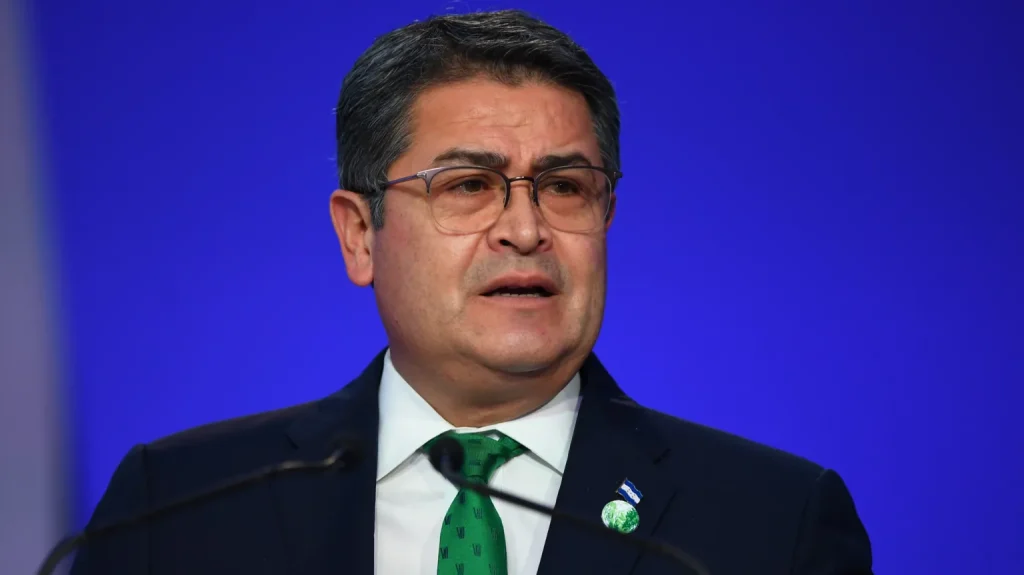
Trump to Pardon Former Honduran President Juan Orlando Hernández, Convicted of Massive Drug Trafficking Operation
U.S. President Donald Trump has announced his intention to pardon former Honduran President Juan Orlando Hernández, who is currently serving a 45-year sentence in an American prison after being convicted of drug trafficking and firearm offenses. Trump made the announcement on Friday, writing on social media that Hernández had been “treated very harshly and unfairly,” without providing further legal justification.
A Former Ally Now at the Center of a Global Scandal
Juan Orlando Hernández, who served as president of Honduras from 2014 to 2022, was extradited to the United States in April 2022. Prosecutors described him as the architect of a drug trafficking conspiracy that smuggled “hundreds of tons” of cocaine into the United States while operating with the protection of heavily armed criminal groups.
His conviction in March 2024 by a New York jury marked a milestone in Washington’s effort to target political figures linked to narcotrafficking operations. The judge who sentenced him called his actions “a betrayal of the Honduran people.”
Trump’s Decision Comes Just Days Before Honduras’ Elections
The timing of the announcement has raised eyebrows across the political spectrum. Honduras will hold general elections on Sunday, and Trump openly endorsed the conservative candidate, Nasry “Tito” Asfura, calling him “a defender of democracy.” He harshly criticized the left-wing candidate Rixi Moncada and the centrist Salvador Nasralla, labeling the latter “a borderline Communist.”
Analysts suggest that the pardon could be part of a broader strategy to strengthen conservative influence in Central America and counter governments that have aligned themselves with Venezuela and Cuba.
Honduras Between U.S. Influence and Regional Pressures
Although the current president, Xiomara Castro, has cultivated close relations with leftist governments in Venezuela and Cuba, she has nonetheless cooperated with the United States on several fronts. Honduras continues to honor its extradition treaty with Washington and hosts a U.S. military base that plays a central role in countering transnational organized crime.
Still, the region has become increasingly unstable. Since August, more than 80 people have been killed in U.S. military strikes on vessels suspected of transporting narcotics. Legal scholars are raising alarms, arguing that many of the targeted boats have not been proven to be carrying drugs.
Political and Legal Implications
If carried out, Trump’s pardon would overturn one of the most significant U.S. drug-trafficking convictions of the last decade. Critics warn it may:
-
undermine trust in U.S. anti-narcotics policies;
-
embolden political actors tied to criminal networks;
-
weaken international confidence in American judicial independence.
Trump’s supporters argue the pardon is an attempt to correct what they see as a politically motivated prosecution.
A Decision with Global Repercussions
As the U.S. moves forward with “Operation Southern Spear,” a military campaign targeting what it calls “narcoterrorists” at sea, the decision to pardon Hernández could reshape U.S. influence in Central America. It may encourage conservative governments to align more closely with Washington, while left-wing administrations may view it as evidence of selective justice.
For now, Hernández remains in federal custody, but the president’s announcement has already sent shockwaves through Tegucigalpa, Washington, and beyond. With Honduras preparing to vote and U.S.–Latin American relations shifting, the political landscape of the region may be on the brink of a dramatic transformation.