Louvre to Raise Ticket Prices 45% for Non-EU Tourists as Museum Launches Major Overhaul After Record Crowds and Security Failures
The Louvre Museum in Paris — the world’s most visited cultural institution — is preparing for a major transformation. As part of a broad modernization plan, its board has approved a 45% increase in ticket prices for visitors coming from outside the European Union and European Economic Area, starting January 14 next year.
This means that tourists from the United States, the United Kingdom, China, Japan, Canada and dozens of other non-EU countries will soon pay €32 for a standard ticket, up from €22. Visitors in guided groups will pay €28 each.
A Strategic Price Increase After a $102 Million Heist
The price hike follows a turbulent year for the museum. In October, a four-person criminal gang executed one of the most daring robberies in modern French history, stealing over $102 million worth of jewelry in just a few minutes.
An official audit conducted in the aftermath revealed alarming deficiencies:
-
outdated surveillance systems,
-
weak coordination among security teams,
-
insufficient staff in key areas,
-
ageing infrastructure vulnerable to structural issues.
Museum administrators argue that a substantial, long-term investment is desperately needed — and that increasing ticket prices for non-EU visitors is the most viable way to fund it. The change is expected to generate €15–20 million annually, all earmarked for renovations and security improvements.
Overcrowding: A Persistent Challenge
In 2024, the Louvre welcomed nearly 9 million visitors, most of them international tourists. Americans alone represented over 10% of all visitors, while approximately 6% came from China.
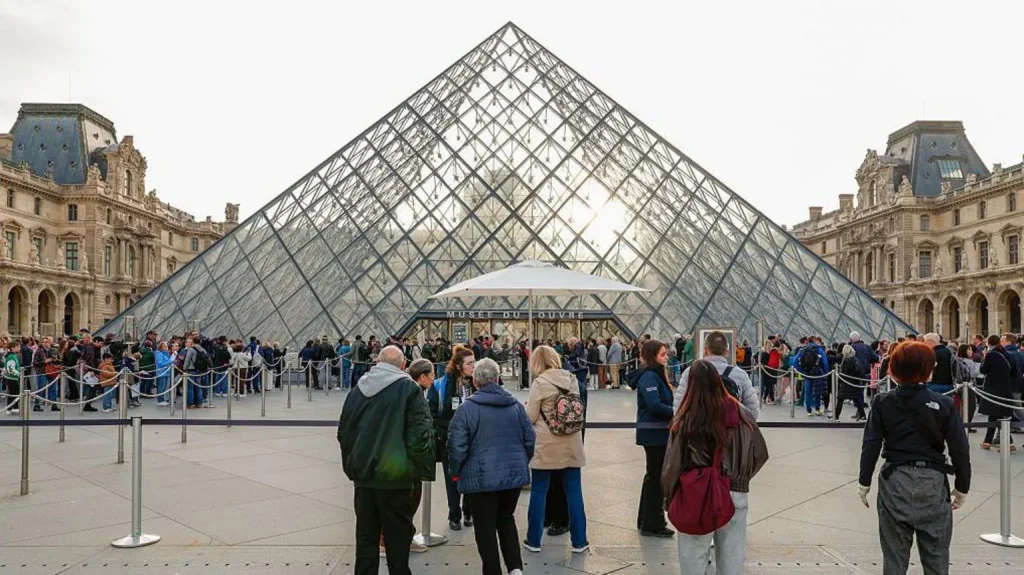
However, the overwhelming number of daily visitors — around 30,000 — has exposed the museum’s limitations. Galleries often become congested, with long queues forming hours before the museum opens.
The most dramatic overcrowding occurs in the Salle des États, home to Leonardo da Vinci’s Mona Lisa. Thousands of people crowd into the gallery every day, often leaving with only a few seconds to view the world’s most famous painting.
Responding to public frustration, President Emmanuel Macron announced earlier this year that the Mona Lisa will be relocated to a larger and more suitable exhibition space.
A Multi-Million-Euro Modernisation Plan
The upcoming changes will be ambitious. The Louvre will:
-
renovate aging galleries,
-
strengthen its digital and physical security systems,
-
redesign visitor pathways to reduce bottlenecks,
-
expand rest areas,
-
create new cafés and restaurants,
-
build additional restrooms to accommodate huge visitor flows.
Some areas of the museum are already showing signs of structural fatigue. Earlier this month, the Louvre closed an entire gallery of Greek ceramics due to safety concerns identified by engineers.
Mixed Public Reactions
Reactions to the price increase have varied widely.
Supporters argue that:
-
the Louvre desperately needs modernization,
-
the price hike is reasonable given the museum’s global stature,
-
international tourists can afford a modest increase.
Critics, however, describe the decision as unfair, noting that it disproportionately affects visitors from developing nations. Some tourism professionals fear the move could deter middle-income travelers and reduce cultural accessibility.
Balancing Accessibility with Preservation
The Louvre insists that the changes are essential for preserving its priceless collections and improving the overall visitor experience. With millions of tourists entering the museum each year, administrators argue that current infrastructure simply cannot handle the pressure.
Ultimately, the price hike represents the beginning of a new era for the museum — one in which modernization, safety, and sustainability take priority, even if that means higher costs for part of the global audience.