Winter is killing faster than the war”: Gaza tents collapse under torrential rains — 260,000 families left exposed as aid is blocked
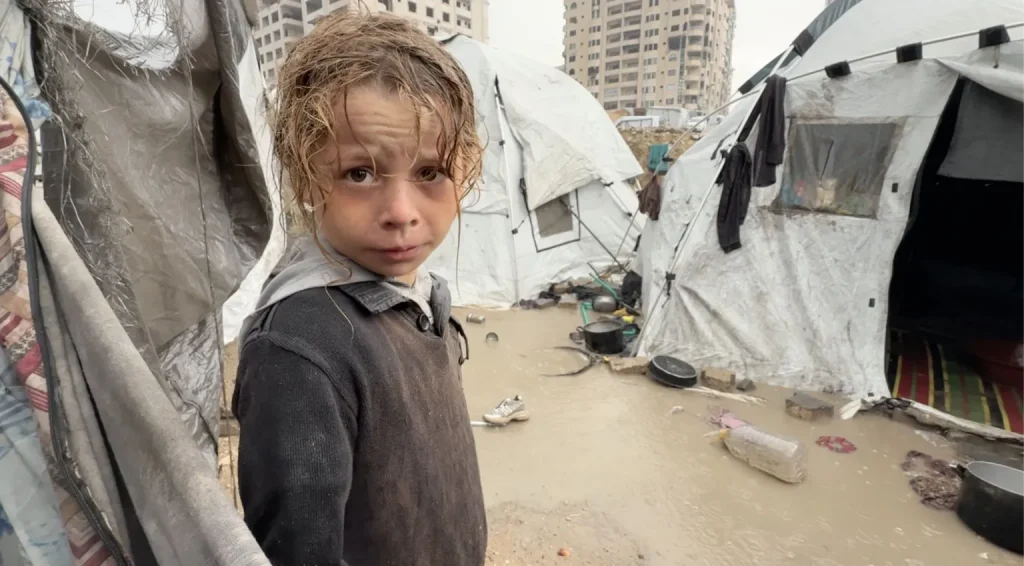
As the first winter storm hit Gaza, entire tent cities were drowned in a toxic mix of rain, sewage and mud. After two years of war and mass displacement, more than a million Palestinians are living in makeshift shelters — shelters now collapsing under heavy rainfall. Aid groups warn that thousands of families and children are at risk of dying this winter unless immediate humanitarian access is restored.
“We are going to lose lives. Children and families will perish,” says Jan Egeland, Secretary General of the Norwegian Refugee Council (NRC), calling the situation “a preventable catastrophe made worse by politics and delays”.
Floodwater mixed with sewage — infection outbreaks already starting
The storm that began on Friday left widespread destruction.
In Gaza City, Fatima Hamdona showed BBC journalists the ankle-deep water inside her tent:
“My children are already sick… and now look at our tent. The flour is wet, the food is gone. We are destroyed. Where are we supposed to go?”
In Khan Younis, the scene was the same.
“Our clothes, mattresses and blankets were flooded,” said Nihad Shabat, trying to dry her possessions.
“We fear it will happen again. We cannot afford a new tent.”
Why shelters aren’t entering Gaza? A tangle of bans, bureaucracy and blocked convoys
According to NRC, 260,000 Palestinian families — roughly 1.5 million people — urgently need proper shelter. Yet only 19,000 tents have entered Gaza since the US-brokered ceasefire on 10 October.
Aid groups say:
-
44,000 pallets of supplies, including tents, poles and bedding, are stuck waiting for Israeli approval.
-
Israel classifies many tent components as “dual-use”, banning them for security reasons.
-
A new Israeli registration process requires NGOs to hand over staff lists — a violation of data protection laws in donor countries.
Israel’s COGAT says it has facilitated the entry of close to 190,000 tents and tarpaulins, but on the ground, NGOs see massive shortages.
Shelters stolen and resold: tents on Gaza’s black market
Some of the few tents that enter Gaza are stolen and sold at exorbitant prices.
Before the ceasefire, a tent cost $2,700 on the black market.
Today it’s $900–$1,000, still far beyond what displaced families can afford.
“Tents survived two years in the sun and two in the rain — now they’re collapsing,” says Alaa al-Dirghali in Khan Younis.
“They’re stolen and resold. I pray the people who actually need them will get them.”
“We need a tent today — not a promise of reconstruction in five years”
International NGOs say the world cannot talk about long-term rebuilding while Palestinians are dying right now.
“It’s pointless to meet in Cairo to discuss reconstruction if Palestinians die before their homes can be rebuilt,” Egeland warns.
In Gaza City, Rami Deif Allah, displaced 11 times, dries soaked mattresses:
“Even the waterproof tent we received is flooded — from above and below. We have nowhere to go. We pray for the war to end so we can rebuild our home with our own hands.”