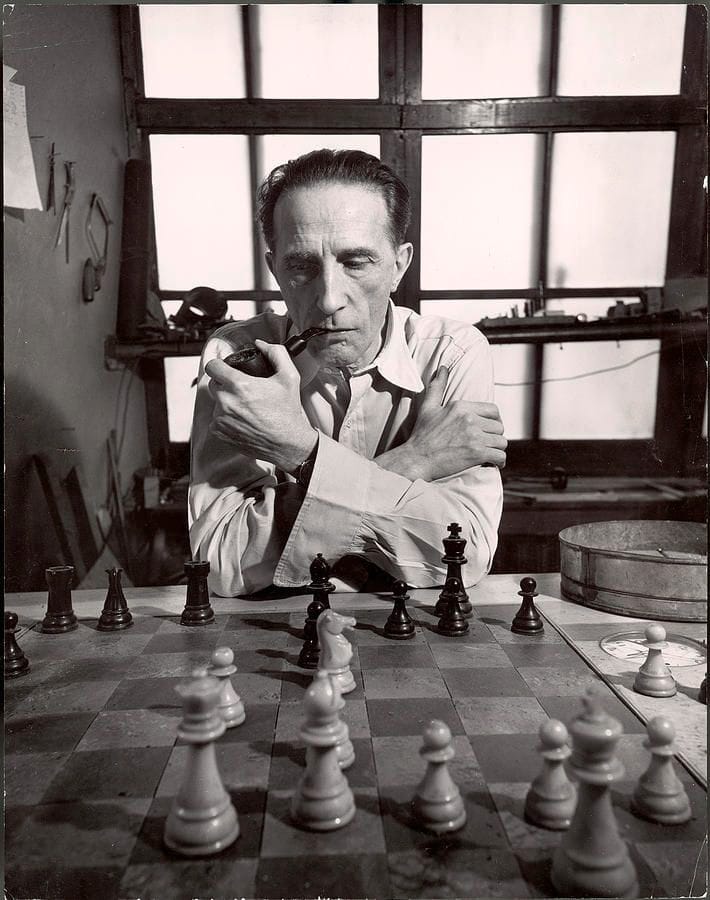
Marcel Duchamp: the artist who checkmated the art world and left the world stunned
In 1917, a porcelain urinal turned upside down and signed “R. Mutt” ignited one of the fiercest debates in the history of art. Rejected by an exhibition jury that claimed to accept everything, the piece — “Fountain” — became a revolutionary gesture. It forced the world to confront a fundamental question: “What is art?”
Marcel Duchamp, elusive and brilliant, was the man who dared to challenge every rule. For some, a prankster. For others, a visionary. For all, the artist who shifted art from the realm of beauty to the realm of ideas.
A mind impossible to categorize
Born in 1887 in Normandy, Duchamp grew up in a family of celebrated artists — yet chose his own rebellious path. His “Nude Descending a Staircase” (1912) scandalized the 1913 Armory Show. Critics ridiculed it, but the painting sold for a high price and cemented his notoriety.
At 25, Duchamp abandoned painting entirely:
“I was interested in ideas, not in visual products.”
The readymade revolution
In 1913 he created his first readymade: “Bicycle Wheel.” An everyday object transformed into a philosophical statement.
But the masterpiece of provocation was “Fountain” (1917). Duchamp bought a urinal, flipped it, signed it, and submitted it anonymously. Its rejection exposed the contradictions of artistic institutions.
His message was razor-sharp:
If the artist choses an object and frames it as art — does technique still matter?
A 25-year artistic “strike”
After shaking the art world, Duchamp seemingly disappeared into chess. He played professionally, competed internationally, and represented France at the 1933 Chess Olympiad. Many believed he had left art behind.
But he was secretly building his final masterpiece.
The secret work revealed after his death
In 1969, a year after his death, the Philadelphia Museum of Art unveiled Étant Donnés, a haunting diorama Duchamp had constructed in secrecy for over two decades: a nude woman lying in a surreal landscape, illuminated by a flickering gas lamp.
A stunning contrast to his anti-art gestures, it reignited debate:
Was Duchamp a conceptual trickster or a meticulous craftsman?
A legacy built on contradictions
He mocked the art market — yet became one of its most valuable figures.
He challenged museums — yet they now treasure his works as icons.
Marcel Duchamp died on October 2, 1968. His ideas, however, continue to reshape art, philosophy and culture.